


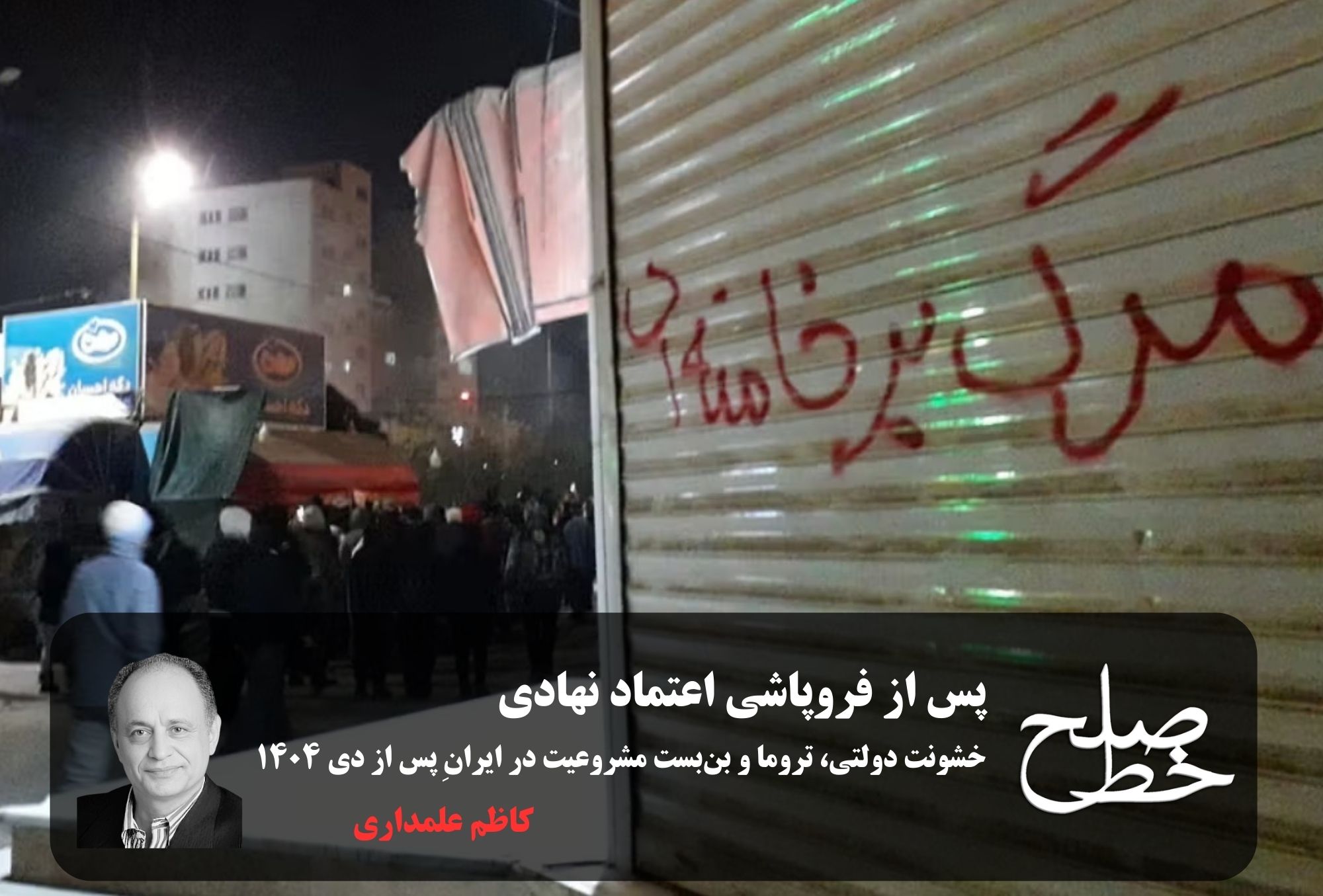
After the collapse of institutional trust/ Kazem Alamdari
Introduction: From political crisis to normative crisis
The political developments in Iran in recent years cannot be analyzed simply in terms of a recurring cycle of “protest-repression.” What happened in the recent uprising—and especially the government’s response to it—reflects the entry of the Islamic Republic’s political order into a qualitatively different phase. At this stage, the crisis of legitimacy has been elevated from a functional and managerial level to a structural, normative, and ethical one.
In functional crises, the government may face discontent due to economic inefficiency or mismanagement, but there is still the possibility of structural reform. In normative crises, the issue is no longer simply “how to govern,” but “the right to govern.” What is happening in Iran today seems to be of the latter type.
The key concept for understanding the legitimacy crisis is the “collapse of institutional trust”; a situation in which official institutions are perceived not only as ineffective but also as morally and symbolically unreliable. In such a situation, the law is no longer a source of security but an instrument of intimidation; the judiciary is not seen as an impartial arbiter but as a party to the conflict; and the official media is seen not as a source of information but as a propaganda arm of power.
Without legitimacy, power often resorts to violence to survive. Signs of a legitimacy crisis include declining political participation, increasing protests, increased government reliance on force, and institutional distrust. The use of force to maintain order and security in society is acceptable when it is accompanied by freedom and justice.
Relying on the theoretical frameworks of Max Weber (legitimacy), Hannah Arendt (power and violence), Jürgen Habermas (communicative action and the crisis of legitimacy), Pierre Bourdieu (symbolic capital), and Jeffrey Alexander (cultural trauma), this article attempts to show that the Islamic Republic has entered a stage of “institutional trust post-apocalypse”; a stage in which the reconstruction of legitimacy within the framework of the existing order faces structural obstacles.
1 . Legitimacy in Weber’s Framework: From Charisma to Institutional Erosion
Max Weber considers legitimacy as the enduring foundation of political authority and divides it into three types: traditional, charismatic, and rational-legal. The Islamic Republic was founded on a combination of charismatic and traditional-religious legitimacy at the time of its establishment. Ruhollah Khomeini’s leadership was endowed with charismatic authority; an authority that stemmed not from law but from the faith and belief of his followers.
But charisma, in Weber’s terms, is an unstable phenomenon and must be “routinized” within stable structures. This process took place in the Islamic Republic through the consolidation of the institution of Velayat-e-Faqih, the redefinition of the constitution, and the concentration of authority in religious-political structures.
With the transfer of leadership to Seyyed Ali Khamenei, the charismatic element gave way to institutional authority. However, this transition did not lead to rational-legal legitimacy; rather, it led to greater concentration of power in security and ideological structures. In this way, the Islamic Republic was established not within the framework of legal democracy, but within the framework of ideological authority.
From the 1990s onwards, the gap between the promises of the revolution—justice, independence, spirituality—and the reality of governance—corruption, discrimination, economic inefficiency—capital eroded the legitimacy of the system. The protests of 2009, 2017, 2019, and 2022 were each a stage of this erosion.
But the mass killing and the official response to it can be seen as the moment when legitimacy fell from the functional to the moral level. At this point, the issue is no longer one of inefficiency; it is one of moral discredit.
2. Violence as a sign of the decline of power: Arendt’s analysis
Hannah Arendt, in her distinction between “power” and “violence,” argues that power is based on collective consent, while violence is a substitute for power in its decline. In her view, the greater the need for violence, the weaker the power.
The widespread use of lethal violence against citizens—especially in conditions of communication blackout and official denial—shows that the state is no longer capable of producing consent. Violence can create obedience, but it cannot create legitimacy. Fear-based obedience is different from voluntary acceptance.
In such a situation, the state may retain the means of control, but it loses power in the Arendtian sense—the ability to mobilize consent. This is the key distinction: a government that is governed solely by reliance on coercion may survive, but it is not “powerful” in the strict sense of the word.
3. Blocking Communicative Action: Habermasian Crisis of Legitimacy
Jürgen Habermas sees legitimacy as dependent on the possibility of rational dialogue between the state and society. In systems with an active public sphere and the possibility of free criticism, crises can be resolved through legal review and institutional reform.
But when concepts like “security,” “law,” and “interest” become tools of elimination, the common language between state and society disappears. In such circumstances, even reforms are interpreted as survival tactics.
In Iran, the closure of the public sphere, restrictions on the media, and suppression of civil institutions have severely reduced the possibility of rational communicative action. This situation is what Habermas calls a “crisis of structural legitimacy.”
Today’s crisis in Iran has transcended the level of economic inefficiency and reached a normative level: the question is not whether the government is efficient, but whether it has the moral right to rule.
4. Symbolic Capital and the Collapse of Authority: A Bourdieuian Reading of the State
Pierre Bourdieu sees the state as an institution that holds a legitimate monopoly on the definition of social reality. This monopoly is based on symbolic capital, that is, the public belief in the validity of the official narrative.
Symbolic capital is eroded when the official narrative about mass violence is inconsistent with the lived experience of citizens. Denial, contradictory narratives, and pressure on victims’ families have exacerbated this erosion.
In such a situation, the state may still retain its administrative and security structures, but it has lost symbolic authority. This is what can be called “command without belief”: obedience exists, but faith in legitimacy has disappeared.
5. Cultural Trauma and the Redefining of Collective Memory: Alexander’s Framework
Jeffrey Alexander uses the concept of “cultural trauma” to describe events that become embedded in collective memory and shape the future identity of a society.
The recent violence in Iran, in a context of denial and cover-up, is becoming such traumas. These traumas are not only reminders of past suffering, but also redefining the horizon of the future.
A society that holds its government responsible for the killing of its citizens does not view that government as reformable. In this sense, moments of mass violence can become historical turning points.
6. Transfer of trust and the possibility of dual power formation
In conditions of collapse of institutional trust, social capital is transferred to informal networks and parallel structures: horizontal solidarity, independent media, protest art, and collective memory.
If this trend continues, it could lead to a situation of “dual power”—a situation in which social authority is no longer exclusively in the hands of the state.
But without a coherent institutional alternative, such a situation can lead to instability. So the collapse of trust is a necessary but not sufficient condition for transition.
Conclusion: After the collapse of trust and the question of the new order
Iran has entered a stage that can be called the “post-apocalyptic stage of institutional trust.” At this stage, the issue is not simply reform within the framework of the existing order, but the necessity of thinking about a new order.
The current crisis is not merely political; it is moral, normative, and historical. The state may survive by relying on the tools of coercion, but it cannot rebuild lost legitimacy.
The fundamental question facing Iranian society is: How can we build a political order that is based on consent, meaning, human dignity, and the rule of law, not on fear and coercion?
Footnotes:
1- Alexander, JC, Eyerman, R., Giesen, B., Smelser, NJ, & Sztompka, P. (2004). Cultural trauma and collective identity . University of California Press.
2- Arendt, H. (1970). On violence . Harcourt.
3- Bourdieu, P. (1991). Language and symbolic power (JB Thompson, Ed.). Harvard University Press.
4- Bourdieu, P. (1998). Practical reason: On the theory of action Stanford University Press.
5- Habermas, J. (1975). Legitimation crisis . Beacon Press.
6- Habermas, J. (1984). The theory of communicative action (Vol. 1). Beacon Press.
7- Weber, M. (1978). Economy and society: An outline of interpretive sociology (G. Roth & C. Wittich, Eds.). University of California Press.
 Created By: Kazem Alamdari
 February 20, 2026
Tags
Hannah Arendt Jeffrey Alexander Jürgen Habermas Kazem Almdari Legitimacy Massacre 1404 Max Weber Peace Line 178 Pierre Bourdieu Political legitimacy Suppression The Di 1404 Uprising Uprising of 1404 Violence ماهنامه خط صلح