


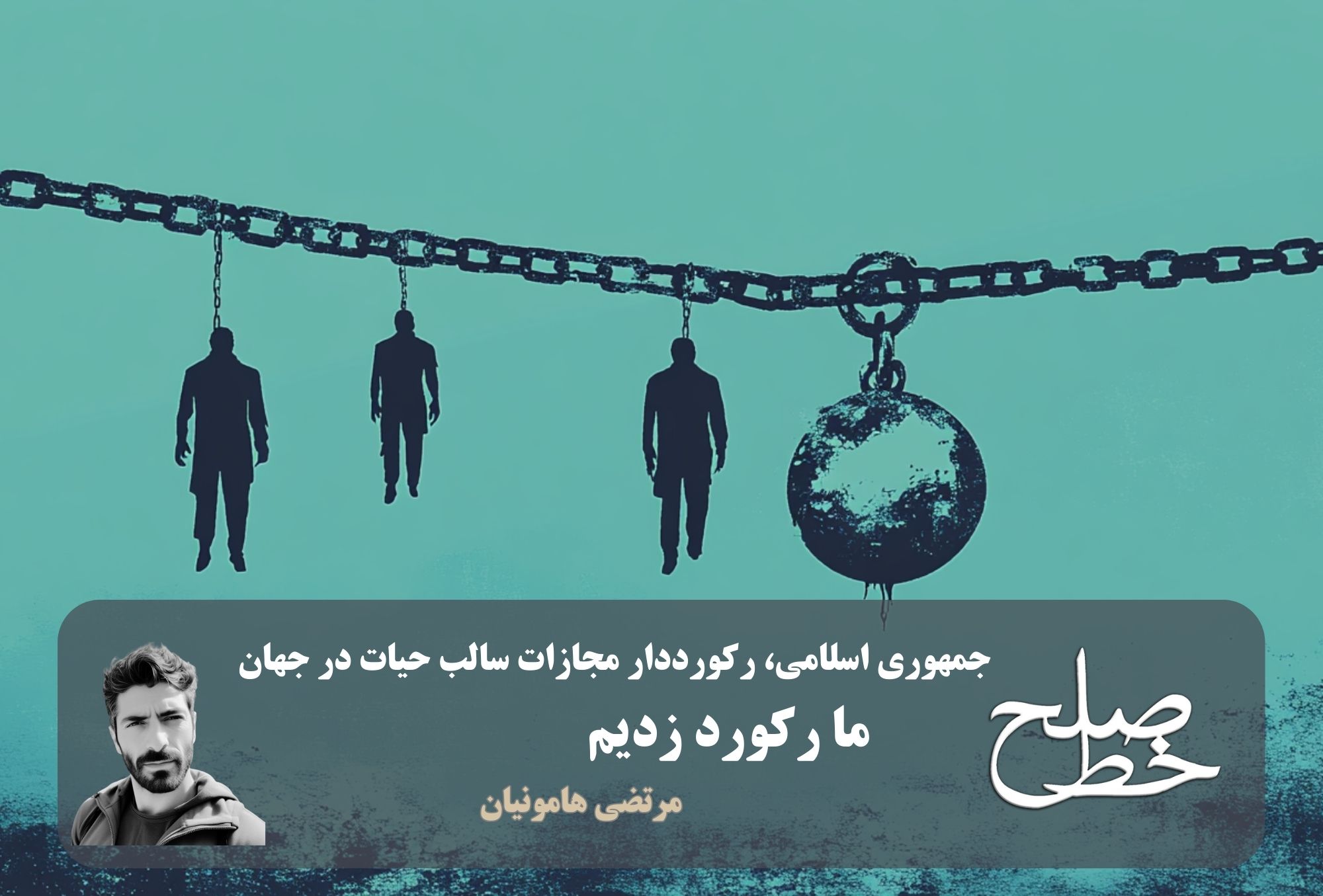
Islamic Republic, record holder of capital punishment in the world / Morteza Hamounian
In the month of Khordad 1391 (June 2012), the leader of the Islamic Republic of Iran said in a ceremony commemorating the anniversary of the establishment of the ruling system in Iran: “We have set a record.” The reality is that he was right; even before that time, the Islamic Republic was one of the world’s leaders in executions and continues to be so. Despite the efforts of Iranian human rights defenders and the international community to put an end to this inhumane punishment in Iran for years, and the efforts of thinkers and writers, from believers in Islam to non-believers, to criticize and abolish this punishment, unfortunately we see that according to the report of Amnesty International in 2024, Iran once again ranked at the top of the list of countries with the highest number of recorded executions. (1) This is while in other countries of the world, with the efforts of human rights defenders, the death penalty is being abolished. As an example
Execution in Iran, after reaching its peak in 2015, was decreasing and had reached its lowest level (only compared to previous years) in the years 2018 to 2020. However, after that, it once again reached its peak to the point where in the past year, it set its own record and with a 14% increase, reached the highest number of executions from 2015 until today, which is the execution of 972 people. This record is only 5 people away from the statistics of 2015, meaning it accounts for more than 50% of all executions in the world. It is worth noting that Iran, Saudi Arabia, and Iraq account for more than 91% of all recorded executions in the world, and in these words, there are hidden messages for those who understand.
An important point in the report of Amnesty International is the emphasis on “recorded executions,” which shows that executions in different countries are divided into two categories: “recorded executions” and “unrecorded executions.” In countries like China, Vietnam, and North Korea, information about executions is confidential and classified documents. In Iran, the government always tries to hide the cases of executions from the public, and what is announced is mostly the result of efforts by Iranian and international human rights organizations who do not allow the government to hide their actions. The human rights activists in Iran, as one of these organizations, have reported 930 executions in 2024. (3) Differences in statistics are seen in cases where information is received from different organizations, from Iranian to international; and according to the report of this human rights organization, 94% of executions in Iran are carried out without official or internal announcement by the government.
What crimes were the accused executed for?
In 2024, more than half of the executed individuals were accused of drug-related crimes. The human rights activists in Iran have announced that 52.69% of the executions in this year were related to these crimes, which means approximately 550 executions in the country. This also means that more than 50% of the executions carried out in the country, which could have been reduced by the law and judges, were still carried out as a form of retribution for drug-related offenses. However, the use of retribution as a punishment for drug offenses is still legal and implemented, as more than half of the executions in the country in the past year were related to this area. Additionally, among the remaining executed individuals in this year, 40% were accused of murder, 2.37% of sexual crimes, 1.72% of unknown offenses, 0.75% of corruption, 0.75% of non-political crimes, 0.65%
According to statistics, executions in Iran have reached a staggering 30% between December 21, 2024 and March 20, 2025. In March 2025 alone, according to human rights organizations, 59 people were executed. (8) This month is when the Iranian New Year and Nowruz celebrations take place, and part of the month is a holiday due to the festivities. This means that if the trend of executions continues, we will face a record-breaking number of executions by the end of 2025. Apparently, the only record being broken in Iran is that of executions. These statistics do not include the executions carried out in April 2025.
The issue is not just the execution of death sentences, but living under the shadow of execution is itself a terrifying nightmare of the daily fear of death and the possibility of not seeing tomorrow. In 2024, 214 people have been sentenced to death in Iranian courts and the sentences of 54 individuals who had previously been sentenced to death have been confirmed by the Supreme Court of the country. (3) In the last three months of 2024, a total of 57 people have been sentenced to death and the sentences of 12 individuals have been confirmed by the highest judicial authority in the Islamic Republic of Iran. (6) This means that the system, in terms of execution, has not only not changed its behavior after breaking its own record, but continues to issue, confirm, and carry out inhumane death sentences and deprive people of their lives with the same command.
What is happening and has happened as executions in Iran is an example of the behavior and performance of a system; a system that, in the summer of 1367, executed thousands of political prisoners who had previously been sentenced and were serving their sentences. A system in which Sadeq Khalkhali, in 1367, after a military attack by an opposition organization in the western part of the country, goes there and executes 300 girls, two of whom were French. The deputy leader at the time says that Baha told him not to execute at least those two French girls, but Khalkhali does not accept it. (9) The point here is that Khalkhali was not officially part of the government in 1367, but he had the power to go to Kermanshah and execute 300 girls. In this government and system, what is worthless are the lives of human beings, and what is considered as easy as drinking water is the
Notes:
1 – Iran is the “world record holder” for recorded executions in the 2024 report by Amnesty International.
Bibisi Farsi.
Bibisi Persian.
April 8th, 2025.
2- Mozakka, Farai, and Zimbabwe abolished the death penalty almost 20 years after the last execution.
Associated Press
December 31, 2024.
3- Annual Report on the Human Rights Situation in Iran; Special for 2024 – Statistics, Publications, and Works of the Human Rights Activists in Iran.
Hoorana.
January 6, 2025
4- The same..
5- Monthly Report; An Overview of Human Rights Situation (December 2024) – Statistical Institution, Publication and Works of Human Rights Activists in Iran.
Hoorana.
January 21, 2025
6- Monthly Report; An Overview of Human Rights Situation (February 2025) – Statistical Institution, Publication and Works of Human Rights Activists in Iran.
Hirana.
, 1 Esfand 1403 (February 20, 2025)
7- Monthly Report; An Overview of Human Rights Situation (February 2025) – Statistical Institution, Publication and Works of Human Rights Activists in Iran.
Hirana.
“1st of Farvardin month, 1404.”
8- Iran Human Rights Organization: 59 people were executed in March 2025.
Deutsche Welle Persian.
April 5th, 2025.
9- Exclusive Bibisi; Audio file of the second session of Ayatollah Montazeri with the 1367 execution committee: “Velayat-e Faqih has become “disturbing”.
“Bibisi Farsi” translates to “Farsi baby.”
April 14th, 2025.
 Created By: Morteza Hamounian
 April 21, 2025
Tags
Addiction Cancellation of execution Justice in humanity Murder Peace Treaty 168 Political prisoners Reproduction of violence