


Cruelty and industrial methods of animal breeding.
Cruelty in industrial methods of animal farming in the meat, dairy, egg, and leather industries is one of the most important topics of discussion for humans today. There are many studies and reports on this issue, but due to the power and control of industries over government regulatory agencies, they have not been able to have the necessary impact on improving standards and practices of these facilities and controlling the treatment of animals in this industry.
Factory Farming (Industrial)
Small farms have disappeared. Farms have turned into huge factories that are only accountable to shareholders and operate solely for the purpose of maximizing profits. In these farms, animals are treated as commodities, objects, or machines. Many of these farms are run by corporations, while others are still managed by large family-owned farms. However, in all of them, the treatment of animals in “production units” is similar.
Cruelty towards animals is one of the fundamental topics.
Knowing about what is done by humans to animals today is of great importance. In this regard, we have translated a section of an article about the breeding methods of cows, chickens, and turkeys in this issue for you, and we are committed to providing our readers with information about breeding other animals such as fish, duck liver, veal, eggs, pigs, and dairy production in the future.

Chicken and turkey.
“;”
Place of growth.
In a factory farm, each chicken is given less than half a square foot of space and each turkey is given less than three square feet. As soon as the chickens and turkeys hatch, their beaks are trimmed to prevent them from attacking each other – due to the tight and unnatural living conditions. This process, called “beak-trimming”, is not done with anesthesia or painkillers and is similar to cutting off the tips of a human’s fingers or mouth. By doing this, the birds are deprived of one of their most important senses – sight.
The trimmed beak chicken cannot search the environment well or clean its own feathers and those of other chickens. Beak trimming also causes constant and intermittent pain in the beak, head, and face of these birds. Recently, beak trimming is less used for “broiler chickens” that are raised for meat, because these chickens are sent to the slaughterhouse in 45 days and are too young to have any understanding of social relationships. This practice is usually used for egg-laying chickens.
Beak trimming is not the only type of surgery for chickens. In one day, their toes are cut off with a 5-inch blade. The colorful beak tip that hangs under the chickens’ beaks is also cut off with scissors, and all of these procedures are done without the use of anesthetics or painkillers, resulting in short-term and long-term pain during the time of organ failure.
Growth.
In factory farms, both chickens and turkeys are genetically engineered and saturated with various antibiotics, resulting in faster growth. In the 1960s, a turkey would reach the age of slaughter in 32 weeks, but today it only takes 13 to 16 weeks. In the 1950s, a chicken would reach a weight of 5 pounds in 84 days, but today it only takes 45 days; meaning these animals die before they can even reach their full size.
Broiler chickens grow so fast that their heart and lungs cannot keep up with their rapid growth, leading to heart failure and death. Economically, it is more profitable for them to grow quickly, even if it means a higher mortality rate.
The turkeys are bred in a way that their chests become so large that they are unable to mate naturally, and artificial insemination methods are used to produce them. Male turkeys used for breeding are kept in darkness and their sperm is extracted from them throughout their entire lifespan. Meanwhile, female turkeys are placed on the ground once or twice a week and their legs are held open with metal forceps, and workers quickly perform artificial insemination on 1200 to 1400 turkeys within 2 hours.
Just like chickens, turkeys also grow at a faster rate and to a higher weight, to the point where their bones cannot keep up with the growth and cause their thin legs to be unable to support their weight, resulting in them falling and getting injured or even losing their lives.
Transportation
In Canada, chickens and turkeys are legally allowed to be transported for up to 36 hours without food, water, or rest to unlimited distances, which is considered one of the worst standards in industrialized countries. The birds are transported in open cages, and due to weather conditions, their mortality rate is very high. The transportation conditions are so inadequate that every year, two million chickens and 20,000 turkeys die during transportation and are delivered lifeless to slaughterhouses. Another eight million chickens and 200,000 turkeys are also harmed during transportation, making them unsuitable for human consumption.
The remaining live birds are treated in the worst way at the slaughterhouse. They are dumped onto conveyor belts with small cranes, and considering that thousands of birds pass through this path every hour, the owners of the slaughterhouses do not waste their time on the birds that fall to the ground.
To kill them, they are hung from their feet on a moving rail and passed through a tank of electrified water to shock them into immobility. In order to prevent potential damage to the bird’s corpse, they are usually hung lower than necessary to render the bird unconscious. From this stage, the birds pass through to have their throats cut by mechanical blades or workers. Usually, the birds flap their wings inappropriately and insufficiently, causing them to be thrown alive into boiling water tanks. The number of these birds is estimated to be one in every twenty and this occurrence is so common in the industry that they have been given a name: “Redskins”.
In an official testimony signed in 2003, a former worker writes: “The chickens that are thrown alive into boiling water flap their wings, scream, and their eyes pop out of their sockets. Due to excessive overcrowding, they usually come out of this stage with broken bones, deformed bodies, and missing body parts.”
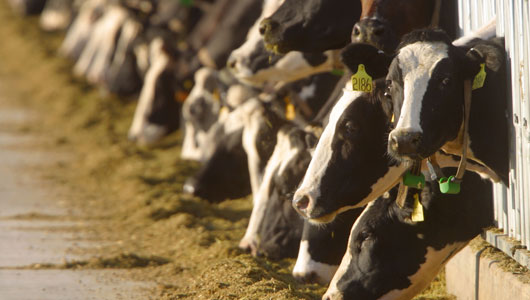
Shame.
A beef cow typically lives between a few months to a year on average, and during this time, no medical services are provided for them. Many become sick and die. The most common disease among cattle herds is “eye cancer”, caused by the growth of a malignant tumor in the cow’s eye, which destroys their face.
Amputation.
Cows are still being branded today using hot iron, just like in the past. A state government website writes about it: “Don’t be heartless”! The branding with iron should be deep enough to burn the hair and outer layer of skin. Cutting the ear tags of cows is also usually used for marking on cows.
In Canada, cows must be identified with tags in their ears, for which their ears are pierced in the middle.
Cows are usually castrated. For this, the testicles of male cows are removed, crushed, pierced, or tied with a rubber band to cut off blood flow. Horns are also cut off. The budding horns of young male cows are uprooted or burned with electric tools. The horns of adult cows must be removed from the base to prevent regrowth, or they are sawed off, resulting in severe bleeding for the cows.
Hormones.
Although growth hormones are banned by the European Union, they are still legal and used in Canada for meat production. Currently, six hormones are used for this purpose: progesterone, testosterone, estradiol 17-beta, which are natural hormones, and three other synthetic hormones. These hormones are usually given to cows through food or by injection under the skin, usually behind the ear.
Transportation and Slaughter.
Three months before slaughter, cows are brought from their holding place to feeding spaces where they are artificially fattened in crowded and manure-filled environments. During their lifetime in Canada, herds of cows are transported thousands of miles multiple times. In Canada, the transportation of cows for up to 52 hours without food, water, and rest, and for unlimited distances, is legal and falls under the worst standards in industrialized countries. The methods of transportation, where animals are moved in different weather conditions, lead to their death. “Transport fever” costs the livestock industry one billion dollars a year.
At the entrance to the slaughterhouse, cows are supposed to be killed with a mechanical blow to the head, but due to the fact that 250 cows have to pass through the production line per hour, this process is usually not done correctly and the cows are still alive, struggling. They are alive, blinking, making noise, and looking around with their eyes wide open. They are alive and alert as they reach the blades. Some of them remain alive until the tail is cut off, the stomach is torn apart, and even until they are hung up; many cows die piece by piece.
Explanation: This article, with a brief summary, is taken from the website of the Animal Liberation Movement in British Columbia, Canada.
 Admin
Admin April 22, 2014