


Conversation with Darvish Dayik, the head of Iran Desk at Amnesty International/ Simin Roozgard
Amnesty International and Human Rights Watch are two international non-governmental organizations that also operate in the field of Iran.
In this issue of the monthly magazine “Peace Line”, we have a conversation with Durrie Dyke, the Iran Desk Officer at Amnesty International and Faraz Sanei, a researcher on Iran affairs in the Middle East and North Africa section at Human Rights Watch, about the security of Iranian human rights defenders and the human rights situation in Iran.
In a detailed interview we had with Dari Dike, he stated that the understanding of authorities in Iran of international standards is limited and the fact that the government’s violent behavior and use of force have taken the place of dialogue within political and social frameworks is a sign that the government does not accept or recognize the expectations of the Iranian people. He also believes that human rights defenders are at risk because they challenge the ruling system with their questions.
Faraz Sanai also emphasizes that human rights defenders are at the forefront of the fight against injustice and discriminatory policies of governments. He says, “Despite the change in tone of the eleventh government compared to the previous one, the human rights situation in Iran has not fundamentally changed.”
Mr. Daik, who is essentially considered a human rights activist and what is the official definition of a human rights activist?
In brochure number 29 of the United Nations, there is talk about human rights defenders. One of the first things mentioned in the brochure about a human rights activist is that: “This is not a job.” A human rights activist can be anyone; a traveler, a lawyer, or a stay-at-home mother who spends most of her time at home with her children, anyone can be a human rights defender. In the framework of international understanding of human rights defenders, in my opinion, this is not a personal job. This work is not like that of a lawyer or someone who holds a specific position in a non-governmental organization. It can even be said that it does not require any special education, and even someone who is illiterate and defends the rights of others can be called a human rights activist. Similarly, a human rights activist can have any profession or be from any country…
Human rights activists, whom I have had the honor of knowing in the past, had a certain capacity and quality. They had a thirst for justice and a fundamental desire in their souls to establish justice. They believed in the idea of reflecting both justice and the fundamental desire for justice in their actions. Even if they were not very familiar with laws and standards, this goal of justice and desire held great importance for them.
Mr. Javad Larijani recently stated that the title of human rights defender is a fake title and we have nothing called human rights defender in the United Nations documents. What is your response to these statements?
Unfortunately, it seems that Mr. Larijani has limited familiarity and understanding of international standards. While he may have knowledge and understanding in Islamic jurisprudence, law, and principles, his statements regarding human rights defenders are indicative of his weakness in comprehending international concepts.
The High Commissioner for Refugees has published a brochure on human rights, a small booklet called Brochure No. 29, which provides sufficient information about human rights defenders and the criteria related to them.
We and our friends who are active in the field of human rights, and our friends who are active in Iran about human rights, have read this brochure. Most of them have sufficient knowledge about the concept, ideas, and principles of human rights.
I was researching about Mr. Larijani for a while. Two years ago, I personally tried to have a conversation with him in Geneva with one of my colleagues, but unfortunately I have to say that the people who were part of the Iranian delegation prevented us from getting close to him and having a conversation. They knew that we work for Amnesty International and they knew that our intention was to ask him a few questions in the form of an interview, but they used pressure and force to keep us away from him. My point in sharing this story is to show that unfortunately the use of force and such behaviors have taken the place of dialogue in Iran. This is a clear indication that the government does not accept or recognize the expectations of the Iranian people and does not even pretend to respect them or adhere to human rights. Unfortunately, Mr. Larijani and his colleagues are not aware of the expectations of the people and international human rights standards.
Do you have an accurate statistic of the number of human rights activists imprisoned in Iran, considering your presence in the International Amnesty Organization?
Good; there is no accurate statistics available, although there are estimated statistics.
Years ago, we decided to conduct accurate statistics, work, and research, but only estimates and guesses can be obtained and our information from cities like Isfahan, Bojnourd, Mashhad, Qazvin, and remote areas is very limited, so we cannot have accurate statistics; However, we do have statistics and the importance of human rights work in Iran is more related to symbolic cases. By symbolic cases, I mean cases like the case of Ms. Sotoudeh or Mehdi Khodaei, who are, of course, individuals, and other human rights activists who are or have been imprisoned. In any case, although our statistics may be small in number, the symbolic importance of these cases is mental and ethical.
Let me give you an example: For instance, if we want to compare, in America, the death penalty is carried out in various forms and the number of execution cases in this country is relatively high. Amnesty International is completely and 100% against the death penalty and we are all trying to oppose it, but we only address some of these cases symbolically and use the reality of these cases and examples to show the reality of the death penalty to the people of the world. For example, as human rights defenders, we symbolically reflect the case of someone who is being executed using an injection.
Iran is also in this situation; just like the case of Mrs. Stouda, where we are dealing with a very strong and emotional person and we are working actively. Perhaps the number of cases of students and lawyers who are trying to improve the level of laws and the quality of justice management in Iran, and we have access to it, may be small but they are very important. People like Mohammad Ali Dadkhah, Mohammad Seifzadeh, Shirin Ebadi, Mohammad Mostafaei, who are of course some of them are outside of Iran and some are under pressure and condemned. Of course, there are also young people whom I prefer not to mention….
The summary of these statistics is that they are not accurate. Even in the case of executions carried out, we can only approximate the minimum number of executions in Iran, but we emphasize that the actual number of executions is likely higher than these figures.
Please note that when we say we do not have accurate statistics of prisoners in Iran, it is not because the issue is unimportant. Any prisoner who has been imprisoned for their peaceful beliefs and behavior has been imprisoned against human rights standards and international norms, and it is important to us. The reason we do not hold campaigns for all of them is not because they are unimportant, but because due to limitations and limited resources, we are often unable to hold campaigns for all prisoners and instead choose symbolic cases to work on.
Why are human rights defenders at risk? Why should their demands be considered a threat to them?
In all parts of the world, human rights defenders are those who challenge the ruling system and raise important questions about the order of their country. If you have seen the movie “In the Name of the Father”, it tells the story of the arrest of a group of four in England, one of whom is a father and the other is his son. There was a lawyer who was in contact with political activists, and they organized a campaign to show the realities of the lives of the individuals in this case and the way the trial and human rights violations were carried out in English courts, and they made great efforts. They were anti-police and against the ruling system of England.
Regarding Iran, it is the same. Some students, lawyers, and union activists, such as those who are active in single-company unions (those who are active in unions, human rights activists), question the Iranian judicial system and the management of the ruling authorities; for example, they ask about the arrest of members of human rights defender groups, the basis for the arrest of a certain person, the lack of access to a lawyer and their family, and so on. These are important and fundamental questions that are raised about the management of the Iranian judicial system, and unfortunately, some governments, such as the Iranian government, do not want to answer these questions. Of course, these questions are left unanswered in the political dimension.
Human rights defenders have recognized their role in raising these questions according to international standards, and we must try to support them. Every government should also protect and support these activists.
Do governments have obligations towards ensuring the security of human rights defenders based on laws or international treaties?
My own experience is limited. I have a brief experience of Afghanistan, Iran, the Emirates, and Kuwait; I must say that these commitments exist, but unfortunately these countries do not act on them.
Of course, there are exceptions, but generally we must know that in Iran, familiarity with a human rights defender by the official authorities of the country is limited; they do not know, or better to say, they do not intend to have a better understanding of this issue. Therefore, their behavior towards human rights defenders in the country is bad.
In my country [Canada], some human rights activists choose a method that is in line with the four pillars of our country’s fundamental rights and expose human rights violations by the Canadian government, which goes against the fundamental rights of the people of our country; whether in British Columbia, Ontario, Quebec or other provinces, they raise difficult questions that hold the Canadian government accountable. Well, the same should be done in Iran. We must know that the Iranian judicial system has major and numerous flaws and this requires a great effort.
Nasrin Sotoudeh and other individuals who are trying to expose the violation of the execution order, or those who have raised many questions in recent years, including student activists and political activists after the 2009 elections, have been recognized by the Iranian judicial system as a threat and danger. However, they must know that these individuals are not a threat, and human rights activists are simply raising questions about the management of justice. In general, when a human rights defender raises criticism, they are thinking systematically and challenging a system, which is the only way to shed light on the ambiguities and weaknesses of a system. This is an important lesson for the officials of the Iranian government.
As you know, the government of Iran is a member of the United Nations Human Rights Council. However, it always views human rights and Iranian human rights activists as dependent on the Western world and deals with them from a security perspective. In your opinion, is this membership in the council and acceptance of its conventions and resolutions on one hand, and dealing with human rights activists on the other hand, not a contradiction? How does this contradiction manifest in the behavior of the Iranian government?
We, the people of the world, as human beings, have accepted an idea and representatives of every nation and people have also accepted it in the international system, which is a collective effort. We have accepted to participate in a common process (the United Nations) with any type of government, morality, religion, or race.
In the United Nations, we have both good and bad representatives. Representatives of dictator governments, countries with kings and queens, and democratic countries that abide by the law, all have become members of the United Nations. Some of the governments that are also members of the Human Rights Council have bad intentions. Some have a rule of law and some do not. In any case, we must be aware of this reality and maintain our peace in the face of them.
Of course, organizations like Amnesty International have the most important task of preparing reports, and from these reports, one can infer whether the system governing the countries from which these reports are prepared is a dictatorship or a democracy. Of course, the type of system, whether communist or liberal, does not matter because our work is not political, but rather we monitor and report on the country’s compliance with human rights laws and standards, and emphasize it.
Iran has the right to be a member of the United Nations and the Human Rights Council, just like any other country. However, simply being a member of these organizations does not necessarily mean that the country respects human rights standards, and this is a misconception. Therefore, the common goal within the United Nations is to improve international standards, and efforts should be made to understand and accept these standards from a moral, social, and political perspective. By recognizing the importance of these common points between a dictatorship, democracy, communism, and so on, we can create a better world because it leads to a shared understanding. For example, every person who is arrested by a government should have the right to access a lawyer. This is an international standard that has become a common practice worldwide, but does Iran adhere to it? No, in Iran, individuals are often imprisoned for months without access to a lawyer or their families, and are often subjected to torture in order to force them to make televised confessions. What
Our mission as human rights defenders, who play a crucial role in these matters, is not only to work on cases in Iran, but also to collaborate with different governments to find better standards.
Do you have any recommendations or solutions for improving the security of human rights activists in Iran?
Unfortunately, I doubt that there is a simple answer to your question. On the other hand, it can be said that human rights defenders must rely on each other in most cases and be more dependent on each other. They must follow each other.
In any case, in a system where, for example, the Revolutionary Guards have such a high role, it is difficult to imagine finding a solution. For example, when Jesus was arrested and taken to prison through phone tracking, if the human rights defenders in Iran had proper education and experience in protecting individual rights and security during their activities, they could have played a more professional and less risky role; of course, I only hope that by achieving such abilities, security can be improved.
On the other hand, sooner or later, a government will come into power that will accept criticism well. It will understand the criticism of human rights defenders, which is within the framework of political and social dialogue, and will protect and support these individuals. However, this remains a dream and is not a realistic option in such times…
And finally, international solidarity with human rights defenders inside Iran is of fundamental importance. Solidarity with the children of Hirana, with the children of Amnesty International and human rights watchdogs is all very important. It is in this solidarity that we, who work in the field of human rights, can gather and publish information about threats, dangers and even research in the field of human rights. This can be a guarantee and support for the protection and security of human rights activists. Of course, this is only possible if the Iranian government intends to respect the rule of law, which is not very practical at the moment.
Mr. Dyke, on the 11th of December 2009, amidst street protests, the information of the Revolutionary Guards of the Islamic Revolution organized attacks against human rights defenders and in their extensive media campaigns, they accused them of being affiliated with Western security organizations or certain political groups. Recently, the head of the Islamic Human Rights Commission, Mr. Javad Larijani, emphasized that Iranian human rights defenders are tainted with terrorist activities. In your opinion, where does this perspective stem from and what dangers does it pose to Iranian human rights defenders? What solutions are there to confront these types of threats and accusations?
See, the rule of law is weak in Iran. However, it must be said that compared to the situation in Afghanistan, Iran has much better conditions. The domestic laws in Iran have many flaws. In the book of Islamic Penal Code, in the chapter that discusses national security crimes, many ambiguous issues have been addressed. We should ask Mr. Larijani, what does taking action against national security mean? Or what does propaganda against the system and disturbing public minds mean?
With these ambiguous laws, even our conversations and the questions you ask may be considered a threat to national security! Because in any case, the structure and even the independence of the judicial system in Iran has been challenged by your questions. So they can easily put any name on larger activities.
We must try to neutralize the weaknesses of laws and the crisis of human rights defenders, both from within and outside of Iran, by working together and supporting them in various ways. We must strive to find new solutions in this regard. We should convince members of parliament, representatives of major foundations, or even the Revolutionary Guards, and make them understand that ensuring the health, unity, and peace of a society will ultimately benefit the country. If the immunity of the Revolutionary Guards and official authorities is reduced, this may be achieved.
As a final question, what message do you have for Iranian human rights activists who are either in prison or working in dangerous conditions?
This is a very difficult question and I don’t know what to say!
Sometimes, a person wants to laugh! As far as I know, you also want to laugh soon! Everyone has a perspective, and this is a kind of perspective that when faced with a difficult reality, you laugh! This laughter shows that your perspective and outlook are positive and optimistic. I want to say that all the human rights defenders I have met so far, all of them laugh a lot and have a positive and good outlook on the future of the world and their desires for the well-being and improvement of the world’s health and behavior in the future. This is very important and my message to human rights defender friends, whether in prison or outside of prison, is to please maintain and support your positive outlook and think about the positive results that will come in the future; not just the long-term future, but also the near future, think about the future of your country and the world. This positive outlook towards the world is very important.
In Iran, there are many examples in this regard. For example, Emad al-Din Baqi, who for a long time has been working on issues such as the death penalty and children’s rights, has been under pressure for years. However, his behavior has been very positive, which shows how hopeful he is. As I mentioned, there is generally hope in the existence of human rights defenders, which shines like a light from within their personalities. The enemies of human rights activists want to extinguish this light, and this is their main goal.
For example, a Basiji took up arms a few years ago and killed Neda Agha-Soltan. What does this symbol mean!? They want to extinguish the light of hope in the hearts of the Iranian people, and this is their fundamental desire. We know that the light of hope has emerged in the hearts of the Iranian people, so we must strive against this neutralization.
In my opinion, human rights defenders should find a common and clear strategy. We should try to act simultaneously to achieve these goals sooner. Having access to a lawyer during arrest can be one of the objectives… We should create opportunities to communicate with each other in order to develop this strategy.
Thank you for the opportunity you have given us.
No text was provided. Please provide the Farsi text to be translated.
Support for the victims of 11 Esfand – Photo of the peace line – Siavash Bahman.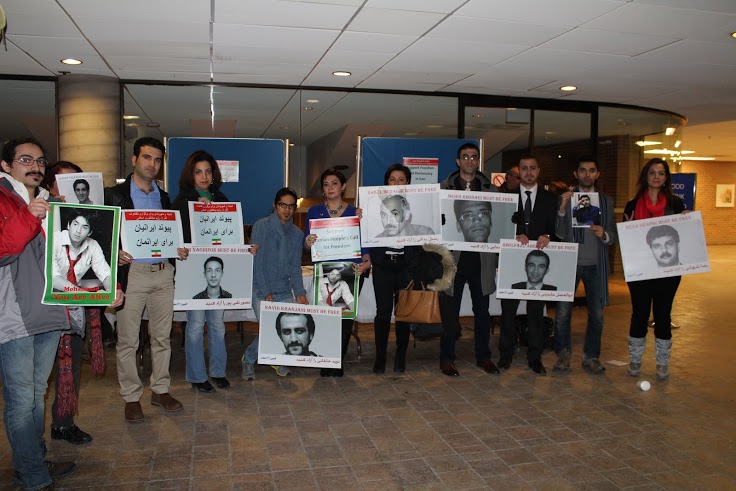
Support for the victims of 11 Esfand – Photo of the peace line – Siavash Bahman
 Simin Rouzgard
 October 15, 2015