


Missing for decades, the secret still remains a mystery / Ali Kalaii
This is a picture of a flower.
Ali Kalai
They came and took me in front of the house. His friends saw that he was arrested on the street. He has been missing since yesterday when he left home.
In the past four decades, these words have been heard from many families. Families who are still searching for their loved ones. Families who still don’t know what has happened to their loved ones. Families who are unsure if their child will ever return or not.
This narrative and these questions are the story and questions of many families who have lost a loved one in the past 37 years. A loved one who was present in a protest and then disappeared, a loved one who was part of a protesting group and news of their arrest was received, and then there was no news of them, and even a child who was born in prison and after a few days of being separated from their mother, goes missing. A loss that lasts for days, months, years, decades…
The black list is a list full of names. From every movement, group, and organization. From every religion and belief. Diverse like the people of Iran, but also united in suffering; like these people who have endured for years.
The disappearance of individuals in authoritarian systems or in governments that do not value the lives and well-being of their citizens is not something that begins or ends at a certain time. The record becomes longer with time. It fluctuates at any given time, but this dark night is not over for all the people of this land until morning.
On August 21, 1980, 11 individuals, 9 of whom were members of the National Spiritual Assembly of the Baha’is of Iran, were abducted during a meeting. Abdolhossein Taslimi, Houshang Mahmoudi, Ebrahim Rahmani, Dr. Hossein Najji, Manuchehr Qaem Maqami, Ataollah Mogharrabi, Yousef Ghadimi, Behieh Nadari, and Dr. Kambeez Sadegh Zadeh Milani, all members of the first National Spiritual Assembly of the Baha’is of Iran after the victory of the Iranian Revolution in February 1979, as well as two other Baha’is named Dr. Yousef Abbassian and Dr. Hashemollah Rouhani, the continental counsellors of this assembly, were also abducted and have been missing for over three decades with no news of their whereabouts.
Shahin Sadeghzadeh Milani, son of Dr. Kambeiz Sadeghzadeh Milani, in an interview with Kayhan London on September 1, 2015, talks about his father: “Imagine my father playing ping pong with my older brother in the morning and leaving the house like any other day, never to return. It’s that simple!”
This is a picture of a beautiful sunset.
Kambiz Sadeghzadeh Milani with his wife.
Kavian Sadeghzadeh Milan, another child of Dr. Kambiz Sadeghzadeh Milan, in a conversation about peace, refers to his family meetings, specifically with the wife of Dr. Kambiz Sadeghzadeh, with Hashemi Rafsanjani, the former speaker of the parliament, Beheshti, the former head of the judiciary, and Ghodosi, the former chief prosecutor of the Islamic Revolution, but no results have been achieved from these meetings and the situation of these missing hostages remains unclear.
Dr. Kavian Sadeghzadeh Milan also mentions that the latest investigations into the fate of their father (who was 42 years old at the time of his arrest) were conducted in 1964 or 1965. Regarding the fate of these missing and disappeared individuals, he tells the writer: “My personal interpretation and opinion is that some of these individuals were killed under torture and the rest were executed and shot.”
Dr. Kavian Sadeghzadeh’s arrest could be linked to his health. The Islamic Republic also arrested the second national gathering of Baha’is in Iran in Azar month of 1360 (December 1981), and after a mass trial, the video of which was released last year by the Tavassoli Foundation after more than three decades, executed them in Dey month of the same year. (1)
The story of the abduction of activists from various groups, however, continues in the 1960s. Individuals who are arrested in groups and then their families never hear from them again. Some of these families, however, have been lucky enough to see pictures of their children in newspapers that have published news of their execution, and become aware of the fate of their loved ones.
In this decade, children are also not safe from the violent storm of suppression. Children who are born in prison grow up and experience suppression in their childhood with their own flesh, skin, and blood. Children who are not even at the age to be separated from their mother are handed over to prison and rulers sit on their thrones while executioners and torturers tell mothers, “You are not worthy of raising a child!”
But this fate is not only for children born or raised in prison. Some of these children find another fate; they disappear.
On the occasion of Norooz 1363, a newborn is separated from its mother for a few days for medical examination, and neither the mother nor any other relatives are able to see the baby.
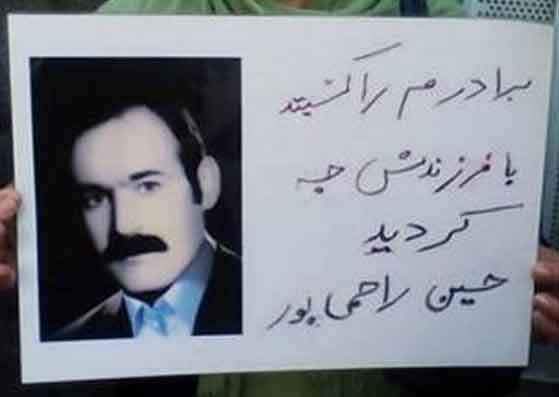
Golro Rahmipour, daughter of Hossein Rahmipour, is born in the early days of 1363. She is taken away from her mother under the pretext of a check-up and examination, despite being healthy, and no response is given to Golro’s mother afterwards. This disappearance is not only specific to Golro herself. Security officials only announce that Golro’s father has been executed, but they do not hand over any body to his family.
Mohammad Neiri, a lawyer in an interview with BBC Persian, says that “there is an interview with Mr. Lajvardi, the former head of Evin prison, in which he says that if these children are raised in a healthy family and are educated, they will become members of the Hezbollah party. The idea behind this is that if a child is raised in a better family, they will not follow in their parents’ footsteps.”
“این عکس یک منظره زیبا از کوهستان است”
This photo is a beautiful landscape of a mountain.
Rahile Rahmipour, the aunt of Golro Rahmipour, has been following her fate in these years.
This statement by Lajvardi can suggest the speculation that these children have been abducted by the security forces of the Islamic Republic after birth and placed in the hands of families of officials and families who, according to the interpretation of the Islamic Republic system, are “Hezbollahi” – and perhaps could not have children – in order to, in Lajvardi’s words, “be turned into Hezbollahi individuals.”
But at the end of this decade and after the massacre of 67, another method is also adopted by the Islamic Republic government to eliminate opponents and make them disappear. Prisoners who are released on furlough and after contacting “infected” messengers associated with their organization, are once again trapped in the web of information and this time they disappear. A story that can be seen as a clear example in the tale and fate of Siamak Toubayi.
Siamak Toubayi, a fourth-year theoretical high school student, is arrested at the age of 18 as a supporter of the People’s Mujahedin Organization of Iran. According to his sister, he did not even participate in the June 9th protests due to his father’s prevention, but on September 5th, 1981, he is finally arrested by being identified by a former schoolmate and member of Hezbollah.
After being announced twice in numerous newspapers and causing distress to his family, he is finally sentenced to 12 years in prison after two court trials.
Siamak Toobaee is one of the individuals who, in Rajai Shahr prison, also known as Gohardasht Karaj, became aware of the government’s intention to commit a massacre and is responsible for the deaths of 67 innocent lives. He and his fellow survivors of the 67 executions, with knowledge of this policy, strive to save their own lives and then, by crossing the borders of our homeland, become the voice of the injustice that has taken the lives of thousands of Iranian citizens in the corridors of death.
Siamak Toubayi returns in Aban 1368 after receiving leave from his mission and attempts to escape, but is caught in the first stage. Due to the involvement of corrupt officials and the complexity of escaping from the forces of the Islamic Republic’s intelligence, he becomes trapped in their clutches.
Nazila Toubaei, her sister, tells the writer that two letters have been sent to mislead their family, but they have been sent in the wrong order. The first letter states that Siamak has arrived at his destination, and the second letter states that he is still in Pakistan and wants to introduce himself to the embassy of the Islamic Republic regime. Nazila Toubaei says that after her investigations, it has been determined that the address listed in the letter sent from Pakistan does not exist.
Furthermore, according to Siamak’s sister, their efforts to follow up with the aforementioned political organization have also been unsuccessful and they have not received any accurate response. Searches conducted in Iran have also resulted in the response that “Siamak Toubayi is missing and we are also looking for him ourselves.”
Finally, through unofficial sources, news of the execution of a brother to his sister and family and other friends reaches. For example, that Mohammad Salami, another missing person for those years, after leaving the Joint Committee prison, went to Evin prison to Iraj Mosadeghi, a writer and other political prisoners, who says he saw Siamak in the Joint Committee and gave the news of his execution to Mosadeghi. A matter that Mosadeghi has also confirmed. (3)
Sister of Siamak Toubayi continues to say that Siamak Nadari, a friend of Siamak Toubayi, after years and leaving Camp Liberty in Albania, has confirmed all of Iradj Mosadeghi’s statements in this regard.
Nazila Toubaei talks about what has happened to her brother and others like him: “Children and even people in their seventies have been executed by invalidating their birth certificates; but then there are those (like their brother) who seem to have never existed at all!”
And until today, the government of the Islamic Republic has not accepted any responsibility in relation to Siamak Toubai and the missing Siamak Toubais; names that are numerous: Javad Taghavi, Mohammad Salami, Behnam Majd Abadi, Hassan Eftakhari and many others.
This image is a beautiful landscape of a mountain covered in snow.
Names and images of 12 missing Iranian Jews.
However, the policy of detention and then disappearance of individuals and not bringing them to justice continued after the dark decade of the 1960s. 12 Iranian Jews left Iran at different times in 1972 and 1973. However, they never reached their destination and their fate remains unknown.
These individuals had illegally left the eastern borders of the country due to the problems faced by the Jews in Iran. Their actions were also disorganized due to lack of coordination among them. Nourallah Rabizadeh, Farhad Azati Mahmoudi, Homayoun Balazadeh, Babak Shaoulian Tehrani, Ebrahim Ghahramani, Cyrus Ghahramani, Omid Saluki, Es-haq Hasid, Ebrahim Kohan Saluki, Shahin Nikkhoo, Kamran Salar and Ruben Kohan are the names of these 12 individuals, of whom there is still no news.
Bijan Khalili, publisher of a book in Los Angeles, America and manager of “Book Company” in 1992, said in an interview about the peace talks regarding the actions taken in this regard: “There is no answer and no one is willing to take responsibility, and practically we are all in doubt about this matter; the only thing that is always said is not to bring it up and not to do such and such because it will probably bring a response.” (4)
He also mentioned in relation to news related to the sighting of these individuals in this interview: “There are also different accounts, for example, a certain soldier said that we saw them, but when they went to find the soldier, he was no longer there; now he has disappeared, either deserted or his service has ended, it is not clear. The situation is confusing and chaotic.”
The fate of the 12 individuals, who are not known and even according to Khalili’s account, those who have given news of these 12 individuals, after being reported, were no longer in their place!
The story of disappearances and vanishing continues; the month of Tir in 1978 and what happened in Iran and in the streets of Tehran University. In those early days, names of the killed and missing were on everyone’s lips. Ezzat Ebrahimnejadi, who was killed and became known as the martyr of Tehran University, and others who were never heard from again.
Saeed Zinali. A student who was arrested only 5 days after the attack on Tehran University and until now, there has been no official news about him. This missing student has only had one short phone call with his family after his arrest and there is no other official news about him. Although there are also other unofficial reports about him.
“این عکس یک منظره زیبا از کوهستان است که در آن آسمان آبی و ابرهای سفید وجود دارند.”
“This photo is a beautiful landscape of a mountain where there is a blue sky and white clouds.”
Father and mother of Saeed Zinali.
Akram Naqabi, the mother of Saeed Zinali, said in 92 that the deputy of Evin prison told her that “until 81, Saeed was in Evin prison and a complete report about him has been sent to the prosecutor.”
Furthermore, Amir Farshad Ebrahimi, a member of Ansar Hezbollah’s personal clothing force at the time, speaks of the torture and death of Saeed Zinali on his website. In an article published in Azar 1393, he writes: “Saeed Zinali was subjected to severe physical and psychological torture during interrogations and confessions, and as a result of this treatment, in Dey 1378, he falls unconscious under torture and is transferred to the Qamar Bani Hashem Hospital in Tehran, belonging to the Ministry of Intelligence. Unfortunately, he passes away in that hospital.” (6)
Ibrāhīmī also says that the security authorities of the reformist government were well aware of the issue, but they remained silent and even after all these years, they still do not speak about it.
…And the family of Saeed Zinali are still searching for any trace or sign of their child, and even Saeed Zinali’s father is arrested for pursuing his son’s situation and is asked not to follow up on his son’s situation! (7)
But the story of an active female student and her disappearance in the events of the Tehran University dormitory in 1978, can even be more strange and difficult than Saeed Zeinali’s story. Farshad Ali Zadeh, a student from Sabzevar and the head of the Al-Zahra University Association, was arrested or kidnapped during the events of the university dormitory and no trace of her fate was found. Her mother, who was a strong activist, could only endure six months of her daughter’s disappearance before passing away due to a heart attack. Farshad Ali Zadeh’s brother, who is a teacher, also tries his best but no trace of this student is found.
Amir Farshad Ebrahimi also talks about Farzaneh Alizadeh, who was arrested by the Sepah and later killed. (8) This is only the opinion of a former member of Ansar Hezbollah and besides this scattered and unreliable information, there has been no official and definite news about this student activist from Al-Zahra University.
However, regarding the missing individuals of Tehran University in 1978, the name of Tara Hamifar must also be added. She was a student living in Tehran University’s neighborhood who was abducted during these events and there has been no news about her whereabouts until now.
The list of abducted names is long. In the years following, with the emergence of social networks and communication structures that were less accessible to the ruling authorities and their ability to monitor them decreasing, the possibility of such disappearances and years of silence also decreased. During the protests after the June 2009 elections, it was these very social networks that came to the aid of activists and protesters, and there was no information, image, or video that could remain hidden and unpublished under the government’s siege.
However, these abductions and disappearances for Iranians, on the eve and after the victory of the February 57 Revolution, were not and are not limited to within Iran. There have also been cases outside the country that should be mentioned if necessary. Of course, these cases are separate from the murders and crimes committed by the security apparatus of the Islamic Republic of Iran outside the country, which includes many horrific massacres of political opponents in public places or in their homes.
Seyyed Musa Sadr, an Iranian cleric who was chosen as the spiritual leader for all Lebanese sects after serving as the leader for the Shia community in Lebanon. In September 1978, during one of his trips to Arab countries, he was suspiciously kidnapped in Libya along with two other Lebanese individuals. The Libyan government never took responsibility for his abduction. Throughout the years, there have been multiple reports of him being alive by former Libyan prisoners, but there is still no definite news about his fate. Even after the fall of Muammar Gaddafi, the Libyan dictator, there is still no clear information about the fate of this abducted Iranian in Libya.
“این عکس یک منظره زیبا از کوهستان است”
“This picture is a beautiful landscape of the mountains.”
Seyed Musa Sadr has been missing since 1357 (1978).
Mustafa Chamran, a friend and companion of Sayyid Musa Sadr and the Minister of Defense of the interim government Mehdi Bazargan in 1979, seven months after the victory of the February Revolution and following the visit of Abdul Salam Jalloud, the deputy of Muammar Gaddafi, wrote a letter to Ayatollah Khomeini, the founder of the Islamic Republic system. In that letter, he criticized the meeting with Jalloud and condemned the criminals who had kidnapped Musa Sadr in Libya, saying: “It is a shame that the purity of our revolution is tainted by the impurities of these criminals.” (9)
There are other cases of abduction as well. In 1361, four Iranians were abducted in Lebanon by Lebanese Phalangists led by Samir Geagea. Ahmad Motavasselian, commander of Mohammad Rasoulollah Sepah Pasdaran, Taghi Rostaghar Moghadam, Seyyed Mohsen Mousavi, an employee of the Iranian embassy in Lebanon, and Kazem Akhavan, a reporter and photographer for IRNA, are among the four abducted individuals whose fate has not been announced yet. Samir Geagea later claimed that these individuals were killed, but this was never confirmed by official authorities. (10) Throughout all these years, despite the good relations between the Islamic Republic of Iran and the Lebanese government, and the presence of Hezbollah as a recognized and affiliated force with the Islamic Republic of Iran in that country, no definite news has been published or announced about the fate of these individuals.
Bijan Khalili had said in 2013 that “Imagine if the Nazis had not been defeated by the Allies and their evidence and archives had not fallen into their hands, it would have been impossible to find evidence of the killing of Jews or the killing of Gypsies (Kolis) and others. The opening of the German Gestapo and SS archives and the liberation of the remaining number of concentration camps such as Auschwitz brought these killings to light. In a closed country like Iran, where they do not allow information to be disseminated in a normal manner and people to become aware, it is natural that they do not allow any documents in this regard to be distributed and they do their best to prevent it from happening.”
He has told the truth. Many names of the missing are still missing and the leaking of information and its serious and continuous publication is allowed. Perhaps it will take time for a fundamental change to occur, for the heart of the security of government homes and their documents to be opened and it to be known how many people have been left behind in this way in Iran. It will be known why the Islamic Republic has never seriously pursued the fate of Iranians who have been abducted abroad and even consider themselves rulers in a way, and perhaps documents will be revealed and what has passed will remain in memories to show that authoritarian regimes are more concerned with preserving their own power than the lives of their citizens. A face and image that in this day and age is no longer more than a reflection on the water.
Returns:
1- Emotional, Sepher, a lost gathering, BBC Persian website, October 11, 2015.
2- Where is Golroo, the missing baby in Ovin? BBC Persian website, 14 Esfand 1394.
3- Masdaqi, Iraj, in memory of the one who lived passionately, a website not for living nor for dying, November 4th, 2008.
Investigating the issue of the disappearance of 12 Iranian Jews in an interview with Bijan Khalili, Khatt-e-Solh monthly magazine, fourth year – issue 31, December 2013.
Conversation between Saeed Zinali’s mother and the website Kalameh, July 9th, 2013.
6- Ebrahimi, Amirfarshad, Saeed Zinali lost their lives under torture, Blog of Things to Say, December 12, 2014.
Father Saeed Zinali: They say don’t pursue Saeed’s case, Harana News Agency, 12 December 2015.
8- What has happened to the angel Ali Zadeh in the university neighborhood? Asre No website, February 26, 2003.
9- The letter of martyr Chamran in protest of Jaloud’s meeting with Imam Khomeini, Imam Musa Sadr News, September 11, 2011.
Report of Mohammad Khatami’s meeting with the families of kidnapped diplomats in Lebanon, People’s Sovereignty newspaper, issue 1840, July 7, 2008.
 By: Ali Kalaei
 April 28, 2016
Tags
18 Tir Ali Kala'i Amir Farshad Ebrahimi Asadollah Lajvardi Babak Shaoulian Tehrani Bijan Khalili Cyrus the Champion Execution Farhad Ezati Mahmoudi Hoomayoon Balazadeh Hope Saluki Ibrahim Ghorbani Ibrahim Kohen Saluki Imam Musa Sadr Iraj Mosadeghi Iranian Jews Isaac hasid Kambiz Sadeghzadeh Milan Kamran Salar Kavian Sadeghzadeh Milan Magazine number 60 Missing Mohammad Neiri Monthly Peace Line Magazine Noorallah Rabizadeh Robin Kohen, Hope of Islam Saeed Zinali Shahin Nikjoo Siamak Toubai Sixties