


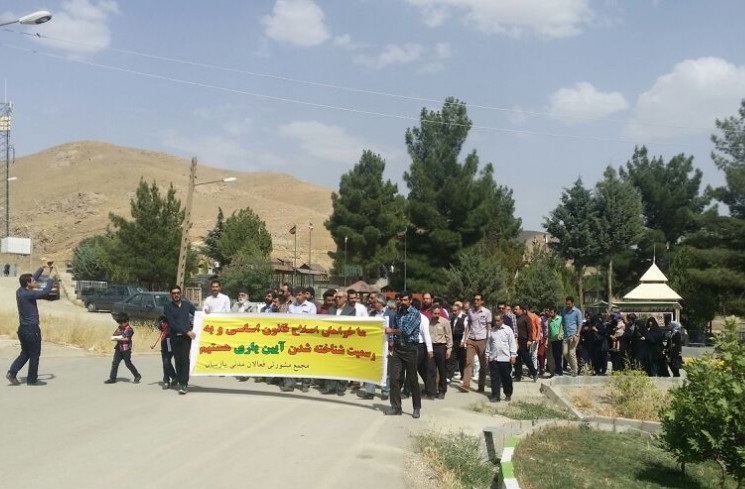
From Myth to Resistance / Reza Shahmoradi
On the occasion of the third anniversary of a citizen’s self-immolation in Yarsani.
“این عکس یک پروفایل است”
“This picture is a profile picture.”
Reza Shahmoradi
The anniversary ceremony of the self-immolation of the late “Nikmard Taheri”, with the presence of followers of the Yarsan religion, ended in Kermanshah while not only the government and the ruling system of Iran did not act according to their promises towards the Yarsan people, but also prevented the commemoration ceremony from being held in the city’s halls. This ceremony was held under strict security measures at the grave of the deceased, and afterwards, some of the participants were interrogated by intelligence agencies. The participants in this ceremony once again demanded the recognition of the Yarsan religion, the respect for their citizenship rights, and the elimination of systematic discrimination by the ruling system.
Three years have passed since the day that a good man sacrificed himself to the fire in hopes of bringing his flames to power and putting an end to discrimination and humiliation. Along with this good man, three others, followers of the Yarsan religion, by the names of Mohammad Ghanbari, Hassan Razavi, and Hekmat Safari, became victims of discrimination and injustice and resorted to self-immolation or suicide. This was followed by widespread protests against the governorship of Kermanshah and the Islamic Consultative Assembly, which were met with suppression and the arrest of many participants. The governor of Kermanshah, Ali Younesi, the special assistant to the President, and Ali Larijani, the Speaker of the Parliament, each separately promised to cooperate and follow up on the demands of the protesters, but unfortunately, to this day, not only has there been no improvement in the situation, but it has even worsened.
The attack on the Yarsan community in Shahabad by radical individuals and lack of pursuit and punishment of the perpetrators, as stated in the recent fatwa by Ayatollah Makarem Shirazi, one of the Shia religious authorities, who had advised his followers to refrain from eating the food of the Yarsan people, disqualifying young and educated Yarsanis and preventing them from entering government jobs and running for candidacy in the Islamic Council, and hindering the free celebration of religious ceremonies are among the signs that the situation is not improving.
The self-immolation of the noble Taheri tells a story of enduring oppression throughout history, and it is not exclusive to today. After the attacks of the Islamists and their successive occupations, most people were forced into converting to Islam. However, there were those who remained steadfast in their beliefs and paid the price for it. Among them were the followers of the Yarsanism religion, whose voices were louder than ever during the time when the Zoroastrian era was known as the “Silent Centuries”. In that tumultuous time, “Balwil Dana” emerged as a leader of the movement for justice and the “Sahrhaldan” who continues to this day. Fearlessly and courageously, he cried out: “I will go everywhere, one by one – I will enlighten and fight – to keep the Kurdish religion alive (which is also mentioned in some sources as the Iranian religion).”
The Freedom Movement of Yarasanis encompasses many regions of Zagros, Iran, Turkey, and present-day Iraq; including Kurdistan, Kermanshah, Lorestan, Azerbaijan, Khuzestan, and even extends to Khorasan and Mazandaran. Some notable examples include the uprising of Shah Khushin in Lorestan, which caught the attention of the Khuramdinans, the emergence of Sultan Sahak in Pardiwar Oraman and the establishment of a new administrative system, the uprising of Baba Yadegar in Dalaahu and his martyrdom in war against the Timurids, the Bakhtashiye and Harufiye movements in Turkey and Azerbaijan, the uprising of Sheikh Reza Dersimi in Bakur (Turkish Kurdistan), the uprising of Seyyed Mohammad Mashashaei in Khuzestan, the emergence of Qushchioghlu from the Forty Thieves in Iranian Azerbaijan, the uprisings of
As an example, the Pardivor movement, led by Sultan Sahak and taking place in Pardivor Oraman, introduces a complete form of a progressive and egalitarian society. Sultan Sahak establishes a self-management system and asks his followers to swear loyalty and remain committed to the founding principles. He organizes his political structures in this way:
1- The “Haftan” or the seven individuals who were responsible for the main management of the organization, and Sultan Sahak himself was one of the members of this group and, like other members, only had the right to one vote. The number seven is also because it is a sufficient number of individuals to make wise decisions and have maximum presence. The number of opposing and supporting votes should also be equal. This principle is still in place in modern assemblies, and the minimum number of members should be seven.
2- Haftavan
3- Seven cups
7- Seven weeks
40 people
40 people
7- Sixty-six loyal men with golden belts (here, “gholam” does not mean slavery but rather a faithful person).
8- Byour has been a thousand slaves who have been a military and popular force.
9- The Seven Female Potters and Seven Water Carriers, whose members were all women, and in addition to that, Lady Razbar as the representative of women, was also one of the main members of the Seven. The poems of Lady Razbar are included in the ritual books of Yarsan alongside other poems and hold a great value and priority.
The ideological framework of Yarsan is a political and social framework, and most of the uprisings have been in this direction. What is happening today in the Rojava cantons is a clear and prominent example of what Yarsan has been and is seeking; a society that governs itself and is based on gender equality.
The fatwas of Shia religious authorities in Iran and the Imams of Friday prayers among Sunni Muslims in Iraqi Kurdistan against the followers of Yarsanism are not limited to today and have roots in history. In the books of Yarsanism, there are many words that indicate this injustice and oppression, for example, in one place it is mentioned (7th century AH): “They mock our morals and manners – and they are proud of their deceit and words from morning till night” (there are some who go to the mosque from morning till night and mock the ways, methods, and words of Yarsanism).
Or in another place, a saying with this meaning has been mentioned: “Their prostration and supplication are like prayer beads and their behavior towards people is always harsh and aggressive – everything about them is love and prayer, but they treat people with hostility and force.”
“Lazoor” is a commonly used term in Kurdish literature and is used when the other party uses force and domination against others due to their possession of resources and power. What is happening to the people today is a clear example of the term “lazoor”. The current government’s actions are such that it not only humiliates and discriminates against its citizens, but also has no qualms about labeling non-Muslims as infidels. However, the civil struggles of the people will not be silenced like previous generations, and their main slogan is “Se Rahê Lêdan Jiyanê – Be Rêxwîdan Jiyanê” (Resistance and struggle is life). The fight for human rights and the creation of a system in which the citizens can manage and be involved in their own destiny, regardless of religion, race, or background, and each person can contribute according to their abilities. This resistance is a difficult and costly path, a resistance that is freedom and struggle
 By: Reza Shahmoradi
 May 23, 2016
Tags
Companion Monthly Peace Line Magazine Nikmard Taheri A virtuous man named Taheri Reza Shahmoradi Self-immolation Self-immolation of a noble man named Taheri. The ritual of assistance