


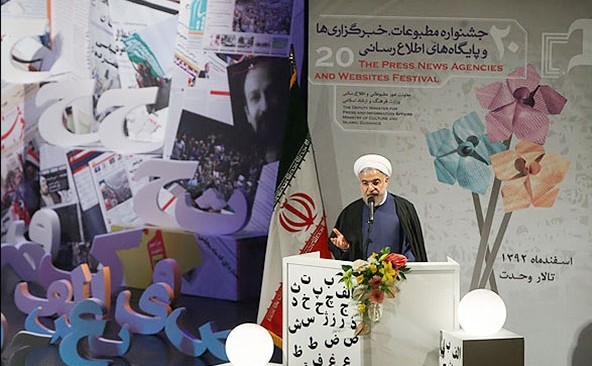
Continued suppression of the media in Rouhani’s government.

Freedom of speech, thought, and pen are fundamental principles of human freedom that are declared in the Universal Declaration of Human Rights as an international covenant and agreed upon by nations to establish a mutually beneficial relationship based on agreed principles and supported by various principles of this declaration.
Print media, as the fourth pillar of democracy and the vigilant eyes of the people, serves as a watchdog over the actions of the rulers and a platform for writers and thinkers to present their ideas and opinions. It is one of the most important tools for having the right to express oneself and using it to share their thoughts and ideas without any restrictions. This right is unconditionally granted to writers and thinkers to express their thoughts, opinions, criticisms, and words.
According to the 2014 report by Reporters Without Borders, the Islamic Republic of Iran ranks 173rd out of 180 countries in terms of media freedom. Based on this organization, the most dangerous country for journalists is Syria, which is currently at war.
The fundamental principles of this organization for ranking countries in the issue of media freedom are: “level of suppression and pressure, pluralism, independence, public space and self-censorship, legal frameworks, transparency, and infrastructure capacity.” Based on reports and in addition to its own ranking, Iran has been recognized as one of the top 5 countries in the world with 50 imprisoned journalists and bloggers.
It is enough to know that based on this report, our neighboring country, Afghanistan, with a rank of 128, has a significant gap with Iran’s rank at the bottom of this ranking. Afghanistan, which still has the shadow of the Taliban over some of its states. This ranking was published before the start of the recent presidential election process in Afghanistan and in February 2014.
The emergence of the Rouhani government as a moderate government with the slogan of “prudence and hope” has not been able to bring about any significant changes. According to the laws of Iran, the responsibility of media censorship falls on the Press Supervisory Board in Iran. The members of this board are: “one judge appointed by the head of the judiciary, the Minister of Culture and Islamic Guidance or his representative, one representative from the Islamic Consultative Assembly appointed by the parliamentarians, one university professor appointed by the Minister of Higher Education, one media manager appointed by them, one professor from the Qom Seminary appointed by the Supreme Council of the Qom Seminary, and one member of the Supreme Council of the Cultural Revolution appointed by the Council.” Among these members, as mentioned and based on the authority and power of the President stated in the Constitution and relevant laws of the Islamic Republic, only one member can have any influence with the approval of the President and in fact, they are under
The newspaper “Bahar” was the first victim of this era. An article by Dr. Seyyed Ali Asghar Ghorooye Esfahani, who is also responsible for the Isfahan branch of the Iranian Freedom Movement, caused its confiscation in this newspaper. This article was about the issue of imamate by Dr. Ghorooye. A discussion that he and his late father, Ayatollah Ghorooye Esfahani, had repeatedly raised. But this discussion and its publication in the “Bahar” newspaper led to the confiscation of “Bahar”.
After the spring, when it was seized on the sixth of Aban month in 92, newspapers of Nashat and Ham-Mihan did not even reach publication and were confiscated before being published. It seemed as if spring had not come and the afternoon of moderation, planning, and hope was turning towards autumn.
Among the newspapers of moderate and reformist views and close to the president, the newspaper “Aseman” was also a victim of confiscation. The newspaper “Aseman”, which was previously a weekly publication with the same name, was confiscated after being converted into a daily newspaper and under the pretext of publishing an article titled “Inhumane Retribution Bill”, which was actually a transcript of Dr. Davoud Hermidas Bavand’s (a member of the central council of the National Front of Iran and a professor of political science) memories. In that speech, Dr. Bavand was discussing the National Front’s position on the Retribution Bill during the 1960s, which was not tolerated and led to the confiscation of “Aseman” by the authorities.
Of course, the arrests were not just a gift for the supporters of the president. The fundamentalists and the extreme right-wing were also not left out of this gift. On January 7, 2014, the publication of the magazine “Yalasarat al-Hussein”, one of the extremist and weekly publications of the Ansar Hezbollah organization in Iran, was arrested. On February 6, 2014, the magazine “Nuh Di” also tasted the arrest, firstly to make the number of publications arrested by both sides equal, and secondly to announce the beginning of a struggle for power in the media in Iran. The meaningful arrests of publications close to the reformists, under the pretext of insulting the Shia imamate and religious issues such as retribution, and the arrest of two main publications of the most extreme fundamentalist and pro-government movements, reveals a struggle in the media between the obvious media managers.
The new year was not a happy year for the press. After the black Friday and severe beatings of political prisoners in Evin Prison’s Ward 350 and the removal of Ismaili, the former head of the prison organization, the Ettelaat newspaper published a headline about his dismissal, which led to the confiscation of the newspaper for three days. On April 29, Ettelaat returned to the media scene in the country. However, the latest victims of the Iranian press were the newspaper and websites of Ghanoon and Dana News, which were seized according to the announcement of Abbas Jafari Dolatabadi, the prosecutor of Tehran, for publishing news about the arrest of General Rouyaniyan and his release on a bail of 100 billion tomans. A news that seemed unbelievable and first Dana and then Ghanoon, quoting Dana, celebrated their own confiscation.
The first season of the year has not yet ended and the media landscape in Iran is very tumultuous. As mentioned, there have been seizures and undoubtedly, even unborn fetuses that have been suffocated in the womb can be observed in the media, whose work has not even reached the stage of obtaining a license to be seized.
However, these detentions were not without protest. After the detentions, the government’s defenders in the media criticized the president for his ignorant and uneducated policies and demanded the presence of university professors and experts in relevant fields. This issue seemed to only involve those in power and only a few days later, Dr. Mohammad Maleki, the first president of Tehran University, reported threats of arrest and harassment of himself and his son. This behavior and similar actions towards students in detention showed that the president’s invitation did not receive a positive response from security institutions and also affected the state of the system.
After the media exhibition, Hassan Rouhani announced during his speech at the closing ceremony of the media festival: “Undoubtedly, if in a society mouths are shut and pens are broken, public trust will be lost in that society and eyes and ears will turn towards the communication facilities of foreigners. Let the field of pen and the field of expression be open so that truths can be explained to the people and society. Of course, freedom of expression must take into account the historical, cultural, religious, and social conditions of that country and society.” He also continued to talk about the freedom of government opponents and supporters, saying: “How is it that some are free today and some have a small share of this freedom? Critics and opponents of this government are free and will remain free. But let supporters of the government also have freedom and security. They can criticize, especially constructive criticism. This is the honor of the government. I have told the ministers that there should be no complaints from the government towards
What appears to be, is not a good omen for the media in the era of Hassan Rouhani. Considering the two sources of legitimacy of the Islamic Republic system and the legal superiority of the appointed pole by the Supreme Leader over the elected pole by the government, there is a legal superpower in this structure that can neutralize the efforts of the elected branch. However, the Rouhani government has shown at the end of 2013 that it is a proponent of confrontation and retaliation. In the face of the detention of his supporters, he turns the game towards the detention of the opposing party, and of course, in the midst of all this, the main victims are journalists, media, and freedom of speech.
It is worth noting that the fourth pillar of democracy and the watchdogs of civil society have never been recognized by the rulers of Iran. The media, and of course other news outlets, have always been seen as a tool for promoting the ideas of the rulers. Any movement that has come to power has attempted to strengthen its approved forces and has either tried to keep independent media alive (such as the Iran Outlook of Engineer Meisami) or has resorted to confiscation, closure, and revocation of their licenses.
Furthermore, another issue that has started quietly is the involvement in the February 2016 parliamentary and Assembly of Experts elections. In addition to the usual sensitivity surrounding parliamentary elections, this time the simultaneous occurrence with the Assembly of Experts elections has doubled the sensitivity of the issue. The advanced age and illnesses caused by old age, as well as the assassination of the current leader of the system in July 1981 and the eight-year term of the Assembly of Experts, have complicated the issue and sparked conflicts between the two factions, which is also a major reason for the arrests of members from both sides.
In general, Iran is still one of the top 5 countries for imprisoning journalists, and with a record of 9 media outlets being shut down in the past 10 months, after the inauguration and signs of increasing tensions, there is no hope in sight. President Rouhani makes beautiful speeches, but given the limited power he has against the appointed branches of the judiciary, they are more like slogans and words rather than actions. And in fact, as history shows, the media has always been the main victims of internal conflicts within the system. Until now, Rouhani’s situation is unclear and the future is uncertain.
1- For more information, refer to the Reporters Without Borders website.
2- You can read the full text of President Hassan Rouhani’s speech at the closing ceremony of the 20th Press Festival on the President.ir website.
 Admin
Admin June 23, 2014