


Gender discrimination, women’s human rights and sports / Elaheh Amani
This is a picture of a cat.
Goddess Amani
The right to access and participate in sports and group games is considered one of the human rights of women in many international documents, including the Universal Declaration of Human Rights (Articles 24 and 27), the International Covenant on Economic, Social, and Cultural Rights (Article 15), the Convention on the Rights of the Child (Article 31), the Convention on the Elimination of All Forms of Discrimination against Women (Articles 10-13), and the Convention on the Rights of Persons with Disabilities (Article 30). According to international laws, governments are obligated to take necessary measures to eliminate gender stereotypes (Article 5 of the Convention on the Elimination of All Forms of Discrimination against Women) in various areas, including women’s sports.
Despite the international laws that member countries of the United Nations are committed to, and despite the positive steps taken in the past 50 years towards providing women with access to sports facilities and physical activities, respect for women’s human rights, gender discrimination in the field of sports, and the restrictive policies of governments under the guise of culture, religion, and localization of international laws remains a long road ahead at the global level.
The reality is that sports is a phenomenon that includes cultural, social, political, economic, and governmental dimensions in the field of sports, especially women’s sports, reflecting their overall policies and gender policies. Gender discrimination against women and girls in physical education and sports exists in many countries. From the unequal pay for the US women’s football team – who have been a source of pride for the American society – to gender-based restrictions and prohibitions in the field of sports in many majority Muslim countries, from the lack of representation of women athletes in the media to the lack of supportive facilities and spaces for women, we witness gender discrimination in the realm of women’s sports.
The gap between the presence of women and girls compared to men in the field of sports is also one of the issues that requires social and cultural campaigns, which can be seen in many countries, even in countries where women have equal rights legally.
For example, in England, the gap in sports participation between girls and boys in schools is growing; because many girls do not have much interest in participating in this field due to lack of confidence in their athletic abilities. These trends, in the light of massive media discrimination in the field of “beauty” concepts, using women’s bodies as tools, objectifying women’s bodies with the standards of the fashion world and strict diet regimes, alongside the absence of women who can be role models in sports, create social challenges for women and girls in sports.
From a public health perspective, the presence of women in various sports can lead to a reduction in diseases that account for 60% of deaths worldwide. According to research by the United Nations on women, gender equality and sports, especially during the formative years, is crucial for the empowerment of girls; as young girls have fewer opportunities for social interactions outside of the family. In addition to the physical and mental benefits of sports, group activities can serve as a platform or opportunity for girls and women to acquire leadership and management skills. This is because women and girls can use the lessons learned from sports in other areas of their social presence, including civic engagement, professional life, and even family management. Abilities, determination, commitment, team spirit, collective action, solidarity, negotiation, interaction, and respect for the rights of others are values that can not only enhance the sports experience for women and girls, but also play a crucial role in achieving gender equality and empowering women.
Susan B. Anthony, a 19th century American activist who made great efforts for social reforms benefiting women and played a key role in the women’s suffrage movement, has a thought-provoking quote. She says, “Of all the things that have been a source of freedom for women, bicycling has done more than anything else. Bicycling gives women a feeling of freedom and self-reliance.”
Despite the fact that today the rules and encouragement of physical activity and physical education for women and girls are recognized, the gender dimensions of sports remain one of the social challenges, especially in predominantly Muslim countries. These dimensions include topics such as women’s hijab and modesty in the field of sports, designing Islamic clothing, media coverage of women’s sports, integration of women’s sports associations into sports federations, and other issues. It should be noted that women in different Islamic countries and Muslim women are not a homogeneous group, and the interpretation and translation of Islam is also not the same in different countries. Therefore, women have different opportunities in the field of sports.
Although in some majority Muslim countries, women’s sports face legal opposition (such as the ban on attending sports stadiums in Iran), even if these legal barriers are removed, gender stereotypes and power dynamics will still perpetuate discriminatory processes. This calls for the development of equal laws and social policies to achieve gender equality and encourage women’s presence in public spaces, as well as a transformation in long-standing power dynamics within society.
Traditional concepts of “housewife” and “man outside”, limitations on women’s presence in public spaces, restrictions and prohibitions on women’s access to sports facilities, lack of encouragement for women and girls to engage in physical activities and participate in sports teams, not only are unhealthy processes in terms of public health and physical and mental well-being of half of society, but also contradict the growing trend of women’s and girls’ presence in the field of sports and are regressive.
The intersection of sports and human rights, which have many common values, has only recently received more attention. It is surprising that the human rights movement, its mechanisms and institutions, and the world of sports have not had a creative and active interaction until now. According to the United Nations Women’s report, this institution has seen progress in recent years through the International Olympic Committee’s allocation of quotas for women’s participation in sports organizations and institutions, while challenges such as the sexual identity of players and the presence of women in sports stadiums and participation in games still exist.
A comparative study of women’s football in England and America.
According to historians, football started in England in 1863 and quickly became a popular and masculine sport among countries in Europe and the world. The history of women’s football dates back to dual and non-dual women’s matches in Scotland and England. With the beginning of the 20th century, women in England, France, and Canada began playing football seriously, and there were also some women’s football matches held in Central European countries. One of the most memorable and historic women’s football matches in Europe took place in 1920 in Liverpool, England, at the city’s largest football ground. In this match, the teams of Dick, Kerr’s Ladies and Helen Ladies Lancashire faced each other in front of 53,000 spectators, and even the doors of the stadium were closed to tens of thousands of others who wanted to attend because the stadium could not accommodate them.
This is a picture of a beautiful sunset.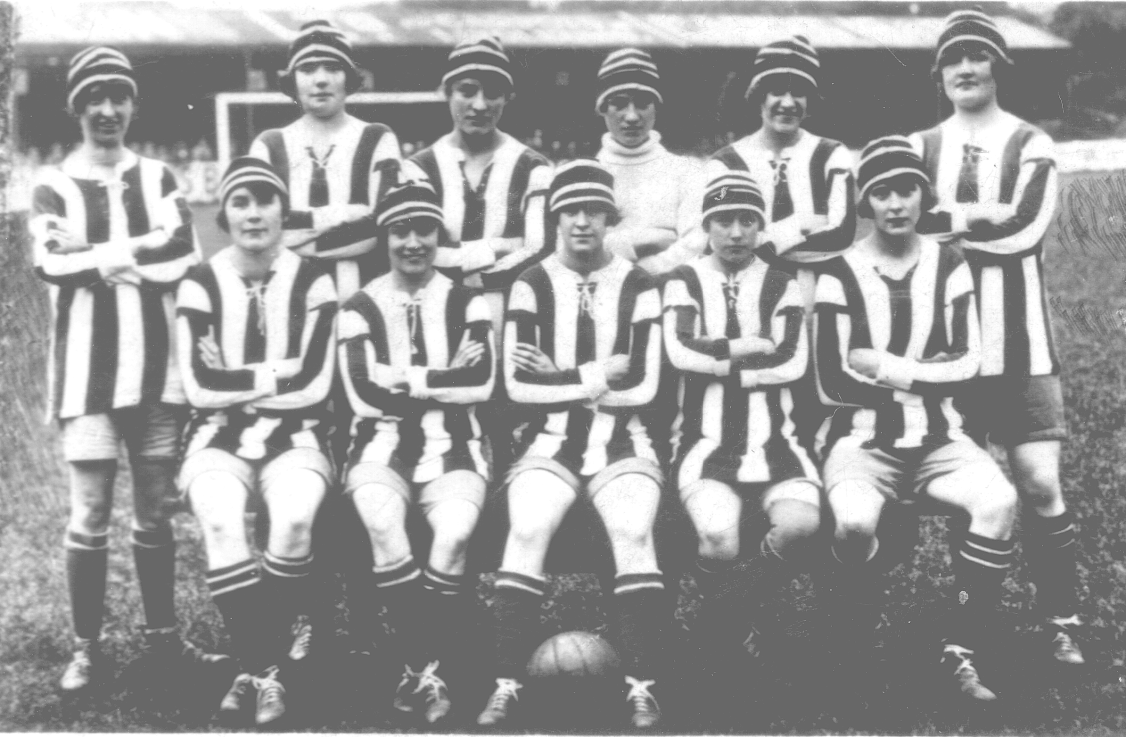
The Dick Kerr Ladies team, one of the first women’s football teams in England – Photo of Jean and Peter Briggs.
The Football Association of London considered this match as a serious threat and in 1921, the most influential football association in England, banned women’s football for 50 years and deemed it illegal. This ban caused various challenges for women’s football in Europe for some time, but in the 1930s, women’s football teams emerged in France and Italy, which continued to operate in the margins and secretly until the end of World War II.
After World War II, the first European Women’s Cup was held in 1957. Until the legal ban on women’s football in England was lifted, many countries had women’s football teams and 35 countries participated in the Women’s World Cup.
Although football started much later in America compared to Europe, its formal and serious form began in this country in the 1970s. However, the first national women’s football team in America started in 1995 and interestingly, the first professional women’s football team in America began in 2001.
The noteworthy point is that the American society has never shown much interest in football. The men’s football team of America does not have a peak or special shine in its resume and currently holds the 24th rank in the FIFA rankings. In contrast, American football is highly popular. But what is the reason for the advancement of women’s football in America to the point of winning championships at the international level?
Researchers in the field of sports attribute the popularity of American football – a highly masculine sport – to, on one hand, the 1972 Title IX law which mandated gender equality in universities and educational institutions and required legal action. The field of sports is one of the areas where gender equality is being achieved in universities and educational institutions.
The book “Finding the Movement” (Women’s Movement) by Anne Enke invites researchers in 2007 (page 4) to examine feminism in unexplored spaces in order to accurately assess the dimensions of the women’s movement in America in the years following World War II. A movement that is referred to as the second wave of feminism in America.
In this regard, the challenges and tireless efforts of women who participated in American football teams in the 1970s and broke into the male-dominated world of American football have been highlighted. These women were actually pioneers who challenged their time and demanded that the public, especially the sports public, not ignore them and that the media cover their sports activities. Endor Lefevre, a professor of “Sports Management” at Adrian College in America, finds in interviews with women in American football teams in the 1970s that many of them, although they broke the structure and challenged the sports world, did not adopt a feminist identity and did not primarily see their activities in relation to the women’s movement. Despite all the efforts of women to enter the field of American football, the presence and popularity of this sport in American society was so heavy that women were unable to have a successful presence in it.
However, the completion of the Constitution has created many opportunities in the field of sports, including football, for women and girls. Neena Chaudhry, director of the Equal Opportunities in Sports Department at the National Women’s Law Center in the United States, states: “I have no doubt that the opportunities we see for women’s football and other sports are due to the passage of the 9th Amendment to the Constitution (which aims to eliminate gender discrimination in educational spaces).”
The American women’s football team participated in international competitions for the first time in 1985. The team, who had quickly come together, received their uniforms the night before departing for the international competition and realized that all the sizes and measurements were for men. The members of the national women’s football team spent the night sewing and tailoring in order to be able to participate in this global competition.
Despite the limited budget for travel and men’s size clothing and other challenges in this World Cup, the women’s football team of America tied 2-2 with Denmark.
After the US women’s national football team won the 1999 World Cup, the fever for football among women and girls in this country rose and this sport became extremely popular among girls. Currently, in many parks in America, on weekends, there are girls’ football teams (even 5 years old and up) playing football. This sport, which is not considered an expensive sport, is also accepted by many families. One of the challenges of football in America is the lack of racial diversity in women’s and men’s football teams. Football players in America are whiter, wealthier, and more educated than the average American society, while in basketball and American football teams, players from lower economic and social backgrounds have a presence in these sports.
“بهترین روزهای زندگی شما همیشه در آینده است، پس هر روز را بهتر از دیروز بگذرانید.”
“The best days of your life are always in the future, so make each day better than yesterday.”
The US Women’s National Football Team – Photo of NBC.
Nowadays, more than 30% of American families have one person who plays football, and American football is gradually losing its popularity among young people due to the risks associated with this sport, such as brain injuries, etc. Families are more concerned than ever about the consequences of this sport. It is noteworthy that during the years 2012-1977, football grew more than any other sport among women and girls in America.
Women’s sports in Iran
One of the most important topics related to women’s sports is public health and hygiene in society. Iran ranks 104th out of 180 countries in terms of health, according to Abdulhamid Ahmadi, the cultural deputy of the Ministry of Sports. He has announced that 50% of Iranian women are overweight, which is a result of a lack of physical activity. Champion sports is one of the demands and desires of women in Iran, and in recent years we have seen more attention from the media towards women’s champion sports, although it is still a serious obstacle and discriminatory in the field of women’s sports.
Despite all the challenges and social obstacles, Iranian women have been able to have a stronger presence compared to other majority Muslim countries on the global stage. Sports and access to sports facilities are one of the human rights of women. In Iran, this right has been gradually improving over the past 37 years, taking into account religious and customary considerations, laws, and prohibitions regarding women’s presence in sports and public spaces such as the beach and the sea. The international community is also aware of the restrictions in majority Muslim countries for various reasons, including cultural and traditional ones, and for this reason, the International Olympic Committee has set a goal to have 50% female participation in majority Muslim countries by 2020.
Dr. Moradi, one of the sports officials, titles the challenges of women’s sports in Iran in the specialized conference on women, sports, and media as follows: “Social factors are the first category of these challenges, and weaknesses in information and necessary advertising, lack of successful role models, neglect of some officials, minimal support from social media, fear of physical injuries from sports, weakness in support from educational centers for sports issues, minimal support from friends for participation in sports activities, and social factors are the main causes. Fear of damaging religious beliefs, adherence to Islamic customs and preserving hijab (when international federations do not require women to wear hijab in sports) becomes a challenge. The presence of a male-centric culture in the sports community, a mindset based on negative effects of sports on women’s appearance, negative attitudes and baseless beliefs about women’s sports, and lack of participation of public institutions in women’s sports are cultural factors. Opposition from parents or spouses, pregnancy and childcare

The challenges of women’s sports in Iran are in line with the challenges faced by women in other majority Muslim countries. Iranian women are currently involved in 40 different sports, but there is a significant gender gap in the participation of men and women in major sports, with men participating 8.6 times more than women. Gender segregation in sports facilities is another challenge, limiting the opportunities for women. Some Iranian female athletes, such as Atousa Pourkashian and Fatemeh Karimi, have to train at home. The government’s budget and investments are primarily focused on men’s teams. Although the media has taken some steps in covering women’s sports events, we still see a lack of enthusiasm and interest in this matter. Gender discrimination in sports is the root cause of gender inequality for women. In Iran and some other countries, women are not considered equal citizens, and discriminatory laws, traditions, and cultural norms, as well as the power dynamics of the patriarchal system, deprive
Sources:
Farsi
1- Shafaf News and Arman News websites.
English
2- The United Nations report entitled “Women, Gender Equality and Sport” on the UN website, December 2007.
Chook, Elizabeth, why is the United States strong in women’s football, website nbc, July 5, 2015.
4- Jenkins, Matt, three reasons for women’s dominance in football in the United States, 18 News website, February 2, 2015.
5- Carpenter, Las, The Challenge of Diversity in American Football: A Sport for White People, The Guardian, June 1, 2016.
6- Muslim Women in Sports, Football Politics Website – Middle East Section
7- Ventisky, Patricia and Hargreaves, Jennifer, “Physical Culture, Power, and the Body”, Routledge Publications, First Edition: November 30, 2006.
8- “Bloomental, Karen, Let Me Play: The Story of Title IX, Book Publication for Young Readers, Literary Society, First Edition: July 1, 2005”
 Elahe Amani
 November 26, 2016