


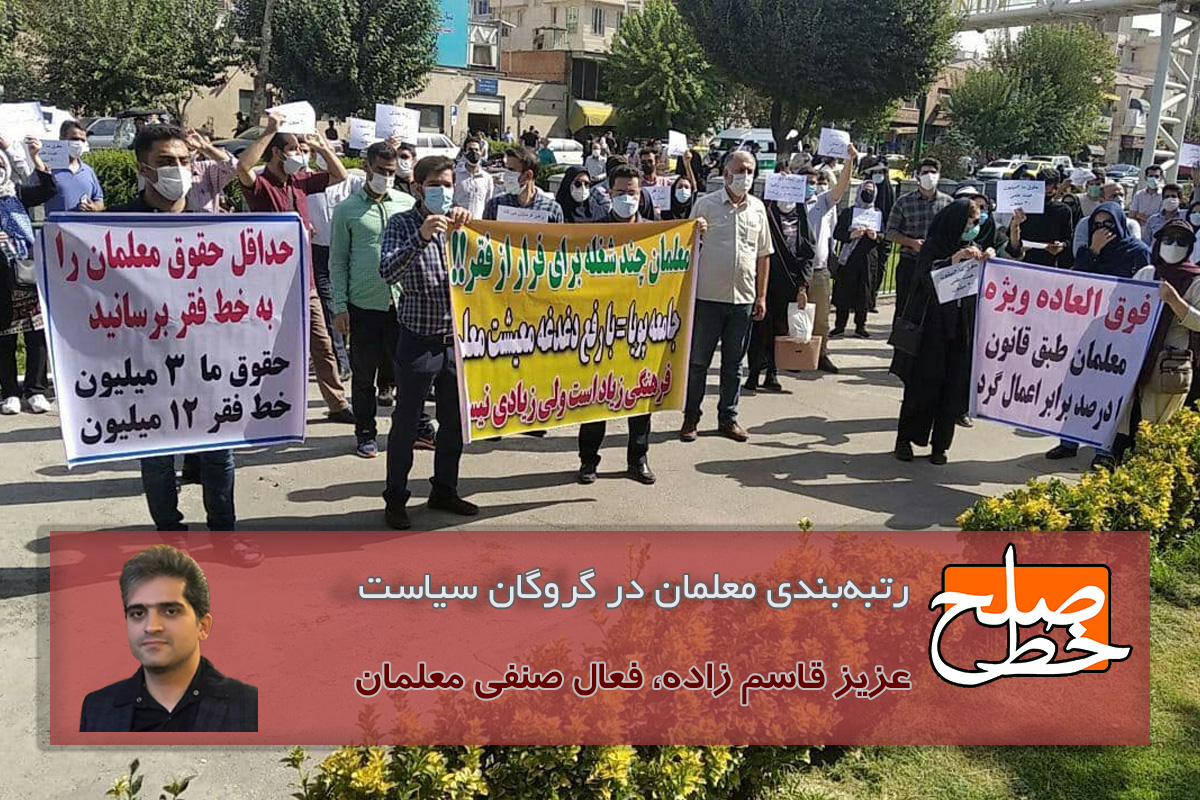
Ranking of Teachers in the Politics of Hostage/ Aziz Qasemzadeh
When we carefully review the story of ranking teachers, it is a suitable example of the type and perception of governance in Iran and the level of respect that decision-makers not only have for their audience but also for themselves. Those who come in front of the cameras and talk about various resolutions and colorful and sweet promises, and behind the cameras, in their minds, are trying to dilute all those resolutions that either are not implemented in any way or are implemented in the worst possible way that limits the interests of teachers.
The story of the first ranking system in the 1970s and during the Khatami reforms was introduced through the school-centered and manager-centered approach, which was quickly rejected. However, the main reason for the introduction of the secondary ranking plan should be attributed to the “Law on Management of Public Services” or the change in the salary system for employees, which has never been implemented for teachers since its approval in 2007 by the Islamic Consultative Assembly, and has caused continuous protests by teachers. Following these protests, on April 6, 2013, the government approved a plan to increase job grades, according to which the score for associate degree was 700, bachelor’s degree was 1500, and higher than that was 2000. This plan was never implemented for almost two years after its approval and the issued orders had different numbers. For example, 800 was considered for bachelor’s degree, which did not exist according to this plan. Following the continuous protests by
“Regardless of the criticism present in determining this triad, the implementation of this plan was carried out in a way that created division among teachers, so that their minds would not turn towards decision-makers; instead of investigating the reasons for discrimination and existing differences, the disabled were engaged in conflict with each other. Similarly, if the privileged conditions for an experienced teacher in high school and elementary school were supposed to be the same according to the announced conditions, in practice there was a difference that caused teachers of different levels to challenge each other, instead of both identifying the source of the challenge. In addition, on the first of Mehr month in 1394, an item called “professional job rights” appeared on pay slips without being included in the approved regulations, with the aim of further limiting the flawed implementation of the ranking plan. On the 30th of Bahman month in 1398, Nobakht, the former head of the Planning and Budget Organization, sent a letter to all departments stating
It is even more surprising that on February 14, 2021, with all the strange and unusual twists and turns, this issue was brought to the parliament and after the approval of its general principles, the Education Committee of the parliament made significant changes to it, which were implemented in a very minimal way. These changes included the fact that in Article 7 – which deals with the 80% equalization of teachers and academic staff – the parliament’s executive committee, with the argument that it is not able to provide the budget for Article 7, prevented it from being included in the representatives’ agenda. In an interview with the news channel of the national television, the head of the parliament’s Education and Research Commission estimated the implementation of the ranking plan to be 160 trillion rials, while in the 2021 budget, a total of 20 trillion rials has been allocated for ranking.
The story of ranking is a complex and deceitful bureaucracy full of decision-making organizations that are not based on accountability and consideration for the suffering of teachers and the chaotic inflation, but rather a ranking process that is carried out in order to support them and manage or control their protests. The problem is that in the eyes of decision-makers, education is not a productive institution, but rather a consumer, and for this reason, it should not be budget-starved. As long as this perspective prevails, the expectation that there will be transformation and bias in favor of teachers in education is a false hope; although when protests are carried out on a larger scale, the balance of power can ultimately disrupt all the schemes against the interests of teachers.
 Created By: Admin
 September 23, 2021
Tags
Corona Dear Qasem Zadeh Extraordinary special Monthly Peace Line Magazine Peace Line 125 Ranking Teacher's demands ماهنامه خط صلح