


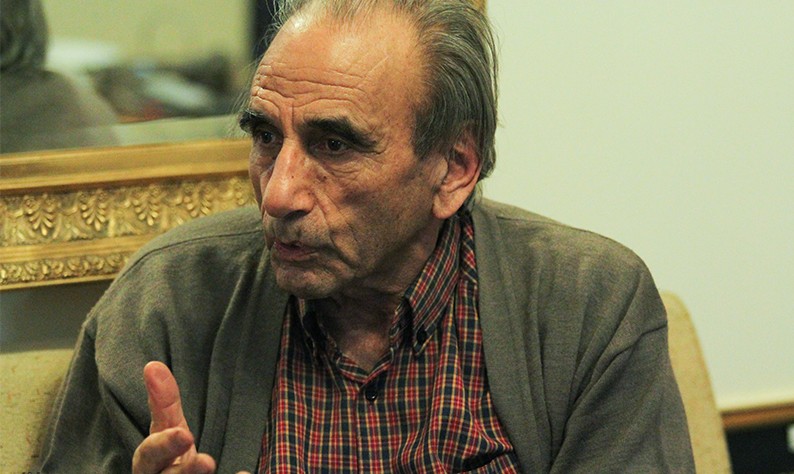
Parviz Kurdavani: We must dry Lake Urmia as soon as possible / Simin Rouzgar
Professor Parviz Kardavani, born in the year 1310 in the village of Mandulak in Garmsar, is an Iranian geographer who has been given the title of “Father of Iranian Desert Studies” due to his valuable contributions in the field of desert science. He has been a distinguished professor at the University of Tehran for two terms and has been selected as a prominent figure in the field of geography. He has authored over 20 books and dozens of scientific articles in Persian, English, and German, and has also delivered numerous speeches at domestic and international scientific conferences.
Professor Kardavani has new and controversial opinions regarding Lake Urmia and believes that it should be “dried up”: “Lake Urmia should currently be dried up in terms of economic, social, cultural, environmental, and political aspects, and transformed into a beautiful botanical and zoological park.”
The father of Iran’s desert studies, in an exclusive interview with the monthly magazine “Khat-e-Solh”, says that all the proposed plans for reviving Lake Urmia will be ineffective and the only solution is to change its land use.
Mr. Kordvani, let’s start the conversation like this, what exactly happened that Lake Urmia has reached this state?
I am myself, and in the year 1345 when I returned to Iran from abroad, I am the founder of Urmia University and I am in love with Lake Urmia more than anyone else, but they did not understand it. During the time (from 1345 to 1347) that I was in Urmia for about two and a half years, I always went to Lake Urmia in my free time or in scientific camps that we organized for students, and my story with this lake begins from here…
It is better to briefly mention the history of this lake before beginning: with the eruption of Mount Sahand, two craters were created, and in one of these craters, water accumulated and turned into Lake Urmia. Its importance was very high. In 1325, when they attempted to identify the country’s water resources, they were forced to divide Iran into 6 basins; one of these basins was the rivers that flowed into Lake Urmia. From this, we can understand the extent to which this lake was large and important, and it was a separate basin. In addition to its own surface precipitation, dozens of rivers from West and East Azerbaijan, Kurdistan, as well as Simineh and Zarrineh rivers flowed into it, and underground waters also poured into it. At that time, this lake had so much water that it even overflowed its surface. Of course, this lake has extremely salty water – but not as salty as the Dead Sea
After the revolution and with the development of cities, industry, and agriculture, the society’s need for water increased and they began building dams. When the dams were built, the water for agriculture, which they wanted to develop to not be dependent on America, decreased. Facilities were provided for agriculture and the Ministry of Jihad and Agriculture provided fertilizers and pesticides to farmers, and the Ministry of Energy also allowed the digging of wells. With this process, they began to draw water from the lake using these wells and about fourteen years ago, people and officials gradually became aware of the decrease in the lake’s water. This was when the voices of environmental extremists emerged – many of whom are only environmentalists and do not have any thoughts or plans in this regard – saying that water should be given to this lake. But giving water to the lake put the surrounding counties at risk of water rationing, and of course, they couldn’t reduce water for industry and agriculture, which needed to develop! Environmentalists say
In your opinion, is the main reason for the death of Lake Urmia the growth of agriculture? Why was there no supervision on this issue?
See, in the month of Mordad last year, Mr. Nader Ghazipour, the representative of Urmia in the parliament, wrote me a letter requesting that you, Mr. Professor Kardavani, use your analysis to present your short-term, medium-term, and long-term plans for the lake. I quickly got up and went to the area, but to my dismay, I saw that they had not understood this great and beautiful lake and had made it sick. They made it so sick that it is now destroying two provinces. Throughout all these years, while everyone was theorizing that we should build dams and divert water to Urmia, they were unaware that farmers were digging wells all around the lake to secure water. At first, they dug 6,000 wells, but there was no particular problem. Later, they dug 18,000 unauthorized wells, and the water level has dropped so much that it’s as if the lake has been punct
The problem was that they hid this illness of the lake. Why didn’t they go to higher authorities, to the President or to the head of the Environmental Protection Organization? Mrs. Ebtakar said that if Lake Urmia dries up, not only our agriculture and villages, but all the surrounding cities will be destroyed. But that’s not the case, and in fact, the more this lake remains, the more damage it causes. Well, many officials don’t know about the problem of Lake Urmia because it’s not their area of expertise.

Currently, is there any solution for this lake? More importantly, what solutions have been proposed or implemented so far?
In my opinion, this lake has been infected with cancer and its cancer is also progressing; like someone who has stomach cancer and later it affects their liver and intestines. The longer it stays, the more damage it causes. Now I will explain the reason for it to you.
During these years, various solutions were proposed, such as dividing the rivers and redirecting all of their water to the lake. However, the Ministry of Energy stated that this was not feasible and that according to the drinking water law, it was a priority to provide water for the people. The governors and members of parliament were also not in agreement. Then they suggested taking water from the Aras River and giving it to the lake, but this was also not possible because we share borders with countries like Armenia and Azerbaijan who do not allow it. They proposed cloud seeding to fill Lake Urmia with water, but this also did not work. They suggested converting the irrigation system to drip and rain irrigation and telling farmers to grow crops that require less water, so that the saved water could be given to the lake, but this also did not work. They wanted to do watershed management, but realized that this method would dry up the lake faster! Because watershed management means using methods in the highlands and
Dear Mr. Kordvani, you have a theory about drying up Lake Urmia and turning it into a botanical park. If possible, please tell us more about this theory and drying up Lake Urmia.
See, to treat this sick lake, they brought specialists from 5 countries who were familiar with issues similar to the Aral Sea and Lake Van in Turkey, but no one could cure it because they didn’t tell anyone that there was a hole under this lake. Now, after all these years and after the debate they had on television, the Minister of Energy has taken this water shortage issue seriously and talked to the President and said that this is a very important matter and you should consider an important person for it! Now that the Deputy President is at the top of the pyramid and Mr. Kalantari, who was in charge of agriculture, is responsible for this task, and of course the responsibility has been entrusted to a working group consisting of Sharif, Tehran, Khwarizmi, Science and Industry universities in Tehran, and West and East Azerbaijan universities, and the governors of these two provinces, as well as Kurdistan province, to prepare and implement their plans for reviving the lake by
But all of these actions, even if they are done, I promise you that Lake Urmia will not be revived; because, fortunately – and I emphasize that, fortunately – there is not enough water to give to the lake and the water situation gets worse day by day. Every day, more and more cities, agriculture, and industry are developing. If there is water, they go and fill the lake, and I, as a Kurd, remain silent about its destruction. This lake needs 28 billion cubic meters of water, and even if 1 billion cubic meters of water is poured into it every year, it will take 28 years for the lake to fill up; provided that there is no evaporation and no holes under the lake! So all of these actions are a waste of time and it is not possible to say that nothing can be done. The truth must be told to bring people out of this state of mourning and spiritual and mental distress. Pouring water into Lake
So, I repeat, this lake was very beautiful and I loved it, but it is sick and has no use; so let’s change its purpose. This lake should now be dried up economically, socially, culturally, environmentally and politically and turned into a beautiful botanical and zoological park. Lake Urmia is like a sick person who has been suffering for a long time and should die, but they keep it alive and torment it.
The first thing they do is collect the salt from the lake. This salt itself is a great source of income; if it becomes an enemy, it will bring good, if God wills. To produce salt, what great expense must be made, but unknowingly billions of tons of salt have been created for us. This salt must be collected as soon as possible so that it does not make the agricultural lands and village waters salty from below, and does not harm the eastern counties by wind-blown dust from above. On the other hand, because the people of the region do not know, they collect and eat this salt and become ill with dangerous diseases, and no doctor can understand the cause; unaware that these salts are poison, they are industrial and not edible salt. For example, Professor Alaa took a sample of this salt to California, USA and tested it there, and came to the conclusion that this salt is the best substance for making toothpaste.
All salt extraction projects in the country must be shut down and they should come and empty the salt from this lake first. If they do so, all the salt will be harvested in one year and if they also sell it, all the expenses of the lake will be covered. Of course, while collecting the salt, they must also dig channels around the lake so that not a single drop of waste water enters the lake; as I mentioned before, the lake must be dried as quickly and completely as possible.
After completing this task and leveling the surface of the lake, let’s come to a diameter of 10 centimeters and sprinkle sand and gravel (90% sand and 10% gravel, because if the sand is empty, the wind will blow it away) along with some plant seeds on the surface of the lake. This area receives 300 millimeters of rainfall and in five to six years, it will turn into a tulip garden and a botanical park, and then release deer, wild boars, and some of these animals there. As a result, Lake Urmia will become the largest botanical and animal park in Iran and the world. They can also revive its 102 islands, which have both tourist and natural attractions. This place will become so beautiful that people will forget the memory of the death of Lake Urmia; like a beautiful child who dies but a few years later, God gives another child to his parents who is even more beautiful. If this plan is too
We must also desalinate the brackish water from wells through artificial irrigation in order to prevent the destruction of the area and revive abandoned villages.

Regarding the problems caused by the drying of Lake Urmia for the people of the region, how much environmental damage has been created so far?
Mr. Nader Ghazipour, whom I mentioned to you, recently had an interview with the National House News Agency and stated that: 50 villages around Urmia have been evacuated and left uninhabited.
Mr. Masoud Mohammadian, the head of East Azerbaijan Agricultural Jihad, also announced in his interview with the media that 204,000 hectares of agricultural land have been affected by the direct impact of the backflow of water from the surrounding wells of the lake and have turned into salt marshes. This has been confirmed by the inspection of the entire country. Mr. Mohammadian also mentioned that the waters of Lake Urmia are also becoming salty, despite the distance. It has been reported for some time now that 19 villages, even their spring water, have become salty.
Mr. Garshasbi, the deputy of water management, also said in an interview with Ettelaat newspaper three months ago (they are just now telling the truth to everyone) that in Lake Urmia, there is another problem called the advance of salty water, which has emerged towards the neighboring agricultural fields through the lake bed. Because the extraction from the tables is more than the nutrition (the same illegal wells that I mentioned) and the substitute water does not penetrate from the upper parts to the tables, the salty water is advancing towards the tables and wells of the agricultural fields in Lake Urmia, which should be considered as a major crisis.
The reasons are the same ones I mentioned to you; in fact, the lake is seeking revenge from the farmers; meaning that the farmers, by digging wells, took the surface water of the lake and dried it up, and now the lake is sending salty water from underneath to their lands and destroying their agricultural lands. So the words I have been saying for years are not in vain and are completely true, but there is no one listening…
Well, this is the first wetland and lake that has not been affected by this crisis and will not be the last; just like the current situation of Anzali wetland or Boujagh wetland in Kiashahr is not favorable. So what is the fate of the country’s wetlands and what will happen?
All of the water that Iran has, was for the wetlands. But we did not deserve it. Humans have destroyed everything. Of course, it is possible to revive other lakes and wetlands, such as Tash, Neyriz, and Hamoon Lake, because only their water has been taken for the use of cities and they have not dug wells around them. The problem with other lakes and wetlands is by no means comparable to Lake Urmia and there is no similar disease in the world.
This issue is not just related to the wetlands. The Karun River, which has also dried up, is also a result of our incompetence and the implementation of unplanned projects in the country. They say we should give water to a province to make it prosperous, while I believe that if we want to destroy a province, we should give it water. They give water to cities and make them prosper, but they do not give water to villagers and farmers. As a result, there is a high rate of migration to cities and as a result, the population of cities has multiplied and they suffer from water shortage. They took water from the Karun and gave it to Isfahan, but now Isfahanis have no water and have become even more thirsty, and Khuzestan has also been destroyed. In the Karun, where ships used to sail and until 1972 it was so full of water that it would flood the city of Ahvaz, now they
Some experts believe that the construction of the Urmia Lake causeway (Kolantar bridge) is one of the main factors contributing to the drought of this lake. How much do you know about the quantitative and qualitative effects of this bridge on Lake Urmia?
First of all, it’s better for this condition to dry up the lake! But I don’t believe that and this bridge has no effect on the dryness. This bridge was supposed to be built as a metal arch before the revolution and not to pour soil; four lanes for cars and two lanes for railways. Later, they came and cut the mountain in the western part of the lake, which had very rich soil, and built this bridge. The problem is that the most important sources of water, Simineh and Zarinah rivers, which are located in the south of the lake, are there and it’s not the water above that dries up….
Dear Mr. Kordvani, thank you very much for giving us your time.
 Simin Rouzgard
 October 23, 2021