


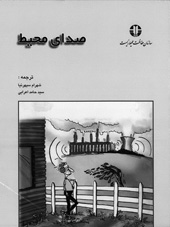
Book Introduction: The Sound of the Environment
بهار در حال آمدن است[/caption]
Spring is coming.
Morteza Esmaeelpour
The book “Environmental Sound”, written by Shahram Sepehrnia and Seyed Hamed Arabi, both of whom are experts in natural resource engineering, has been translated and published by the Green Circle Publishing House in Iran at the request of the Iranian Environmental Protection Organization. Bruel & Kjaer Publishing, the original publisher of this book, has so far presented numerous articles and books on biocentrism and the environment as a whole. The book “Environmental Sound” includes terms and definitions that familiarize us with various environmental pollutants and their extensive dimensions in today’s world.
The mentioned book is divided into 7 sections and discusses sound pollution. The first section covers the concept of sound, common sound levels, and what is necessary to understand sound, as well as frequency weight curves and how changes in these sound levels relate to different types of sound and sound sources. This section also looks at atmospheric reduction, wind, and temperature. The topic of the second section is sound measurement, including measuring sound and reaching an average limit using real statistics, as well as analyzing the frequency or wide range of sound. This brief section also discusses calibrations and certifications for sound damage.
Part three also relates to sound taxes and deals with sound violations and focuses on acoustic fields and environmental sound quality. This section discusses the level and limit of balance and familiarizes users with pollution control measures.
Part four, the section on evaluating noise from industry, road traffic, railway lines, and airplane noises, is included in the assessment report. These predictions are accurately calculated and measured in the sound levels presented in this book.
Part five of this book is titled “Planning”; planning at local and global levels for sound and weight, as well as cost and effectiveness in noise reduction activities. According to Bruel & Kjaer publications, global scales should be evaluated alongside local scales, which is why after the local scale, the global scale is also addressed.
Section six is the sound reduction section. Sound reduction, its source, sound transmission path, and necessary barriers are the main topics of this section. The translators have effectively combined the end of section six and it can be referred to as environmental discussion as it discusses pollutants and barriers in society and the reason for measuring these issues.
The seventh section is also named the permanent monitoring section. In this section, airports, cities, and permanent monitoring systems are discussed, and international standards such as ISO 1996 and ISO 3891, both related to environmental noise assessment and monitoring, are addressed. Additionally, this section covers sound level measurement tools, calculation standards, and other issues.
Sound pollution and its effects are one of the issues that have become more prominent due to the increasing development of societies, especially industrialization. As a result, the need for setting standards for sound and updating them, as well as determining acceptable levels of sound pollution, has become more important. This book, as mentioned, has been translated based on the recommendations of the Environmental Protection Organization of Iran and is written in simple language with specialized concepts. According to the translators, this book can be a reliable source for researchers, students, and even those interested in the environment.
Book Name: Ambient Sound
Translators: Shahram Sepehrnia and Hamed A’rabi
Publisher: Green Circle
First Edition: Winter 1384
By: Morteza Ismailpour June 27, 2015
Tags
Introduction to the book