


One nation or two nations or one divided people?/ Amir Salar Davoudi
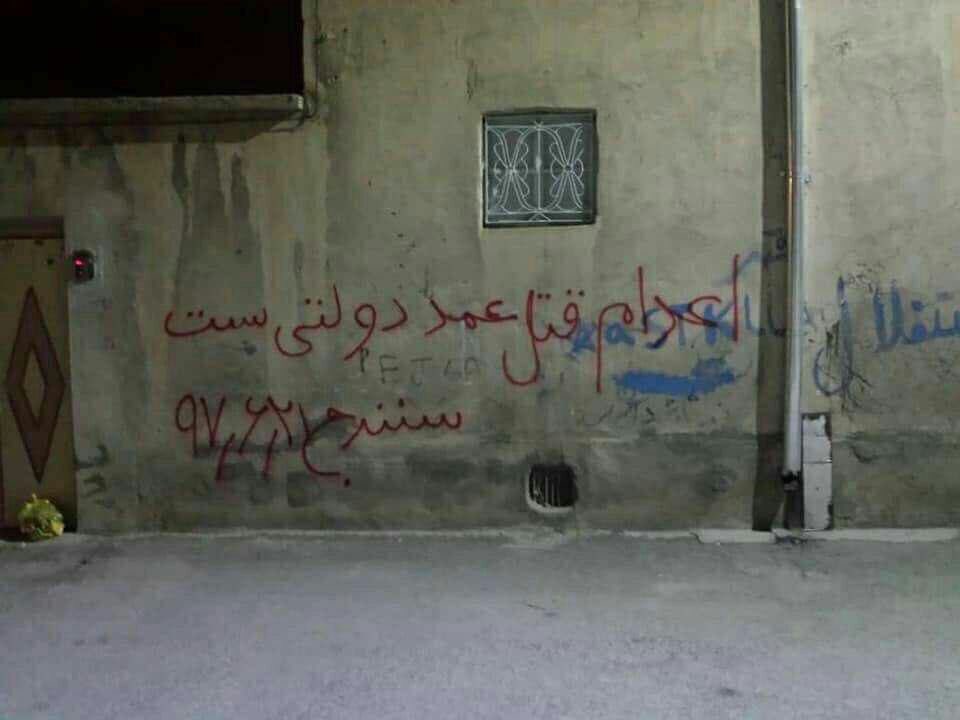
“این عکس یک نمونه است”
This photo is an example.
Amir Salar Davoudi
Executions that are regardless of the nature of the charges against the accused and the manner in which trials are conducted, and whether the judicial proceedings leading to the issuance of death sentences are partially or entirely in line with internationally recognized legal principles on one hand, and in accordance with domestic criminal procedure on the other hand, have been or not? According to the writer, two considerations regarding the principle of carrying out such executions can be taken into account and considered.
First of all, regarding the temporary suspension or delay in the execution of the punishment against those three individuals whose names and identities were Lohman Moradi, Zanyar Moradi, and Ramin Hossein Panahi, it was met with considerable opposition from some members of the public through conventional means such as online petitions and signature collections in public places, or by creating so-called Twitter storms and similar actions, whenever they were put into effect and their demands were met, did anything special happen!?
Does delaying the execution of the mentioned sentences for a few weeks or months result in the decline or weakening of the greatness and authority of the judiciary, or possibly lead to the manifestation of weakness and incapacity of the government?!
Basically, in cases where retrial or application of Article 477 (determination of religious violation) was prescribed for three convicts sentenced to death, but in reality, there was no reconsideration or only a superficial and perfunctory review, and the only thing that happened was a delay in the execution of the sentence for a few weeks or months, something else was happening!?
And such a delay would not only waste the credibility of the judiciary! If such contemplation and patience were taken into account by the judicial authorities, the earth would move to the sky and the power of the judiciary of the Islamic Republic would not be wasted and destroyed all at once!?
In a more precise interpretation, what is the focus of the owner of this pen in the first paragraph is the lack of taste in the actions of the government officials or specifically the judicial authorities in their interaction with public opinions. That is why I have repeatedly emphasized that unfortunately, sometimes in examining and analyzing the performance and policies of the ruling government and its officials towards all or some parts of the people, this strong feeling is transferred to every impartial person and observer, whether it is possible to manage in many areas in a way that all or even some parts of the people do not see the government as a threat against themselves.
I don’t know, but it’s not hard to believe that people often don’t get what they want, especially when their desires are expensive and difficult to fulfill.
It is not considered weakness or incompetence for a government to listen to the demands and persistence of its people with a smile of tolerance and compassion, and to respond and fulfill them with kindness, patience, and contemplation, even if those demands may seem insignificant or invalid. In fact, it is a sign of strength, power, and self-confidence in the government. In this regard, it may be asked why a ruling authority should consider the desires and persistence of a minority, who are only a small fraction compared to the entire nation, in the management of their affairs?
The answer to this question is very simple, unless the company is only a small part of the people in a demonstration like the 9th of Dey 1388, when the wise and vigilant nation responded to the sedition and seditionists and rejected them. Now, in similar cases, we can extend and make incomplete inferences, contrary to the famous saying that extension is not a part of the whole (incomplete inference). Secondly, regardless of the attention and consideration of the ruling authorities and officials to the desires and wills of all or some parts of the people, the question arises as to why, at a time when the implementation of punishments or penalties within the country, due to the presence in the era of exchanging information at the global and international levels, weakens the government in international arenas and we are witnessing various pressures and constraints from all sides against the political and economic integrity of the government and consequently the people, the implementation of such punishments, especially when faced with widespread protests
On the other hand, the late founder of the Islamic Republic, the late Ayatollah Grand Ayatollah Ruhollah Khomeini, on the fourth of Aban month 1360 and among the preachers and speakers of Tehran and Qom and members of the Islamic Propagation Office of Qom and members of the Islamic Association of Tehran Municipality, in connection with the necessity of preserving the Islamic Republic system, said: “Preserving Islam is a divine duty, above all other duties; meaning that there is no duty in Islam higher than preserving Islam itself. And if preserving Islam is among the greatest duties, and in fact the greatest duty, then preserving this Islamic Republic is the greatest duty for all of us, for you, for the entire nation, and for all the clergy.”
Ali, based on what has passed, as one of the emphasized principles in Islam, is to warn against actions that may undermine or belittle Islam, Muslims, and Islamic laws. On the other hand, according to the late architect’s view, preserving the Islamic Republic is equivalent to preserving the integrity of Islam. The implementation of death penalties, which has been the subject of numerous discussions and debates globally, especially in hostile countries towards the Islamic Republic, is a matter that requires rational and logical justification and adherence to the principles and guidelines of just governance. In this regard, it may be argued that if the government pays attention to all the discussions and debates surrounding the implementation of domestic punishments and refrains from weakening the Islamic Republic, it would have to suspend the implementation of these punishments for a considerable period of time. As a result, no criminal would be eligible for punishment and would not face the consequences of their actions. In response, it must be said that such a scenario is possible, and we have
Have we ever examined and investigated the reason for this apparent contradiction in the emergence and occurrence of one being opposition and the other being companionship? Do we have two nations, one being friendly and the other unfriendly? Or perhaps we have a people divided into two groups, one demanding and advocating for the implementation of punishments, and the other stubbornly opposing the execution of punishments! But the answer to this is also very simple and easy…
We do not have two nations, nor are the people of our land divided into two pieces. The key to convincing the public and their consciences is in the hands of those who are aware and knowledgeable, and who can distinguish between friend and foe, and who can see through the complex claims of politicians and support the revolution. When the people – those who are aware and knowledgeable and can see through the signs of the sun – believe that in dealing with the accusations against an individual or individuals, justice, fairness, and integrity have not been considered, and the rights of the accused have been neglected with indifference and tolerance, and the standard judicial procedures have not been followed in proving the accusations, then their reaction will be one of protest and opposition. But if they are convinced that in proving the accusations against the accused, their rights have not been violated and they have received a fair and just trial, then they will stand behind the judicial system with all their might.
Yes, the people of this country are wise, but not just in the political arena. By nature, they possess understanding, consciousness, and insight, which are the qualities of eternal and heavenly beings. When they sit on the shoulders of an individual or a nation, fate and politics will no longer have the power to diminish or lower those qualities and heavenly beings will not provide support for their immortality and elevation.
The people of this country, contrary to all eras and ages, have always been known for their continuous integrity, sharp intelligence, and awareness. Therefore, when they see that according to Article 48 of the Criminal Procedure Code, approved in 2013, only trusted lawyers of the head of the judiciary have the right to intervene in the acceptance and defense of suspects in security crimes, they become aware and ignore the whole situation. In this case, it is undoubtedly possible for the management of security trials to operate under the banner of Article 48, and the founders of such disregard for the rights of the people, which cannot be found anywhere in the history of human trafficking or in any herbal shop, may approve of this careless approach. However, the result will surely not be trusted, supported, or trusted by the people, and expecting trust, support, and trust from the people is an unrealistic and baseless expectation. The people rightly ask themselves where the fate of a collective defense that has only
The end is what flowed from the pen of this writer, a reference to two observations that are important beyond personal considerations and legal and judicial deliberations. Undoubtedly, everything that has happened is subject to criticism and is likely to be wrong.
Salih and Talih display their goods.
What is accepted and what is considered.
 Admin
Admin October 23, 2018