


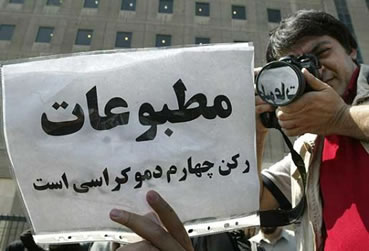
A brief history of censorship in Iran from the beginning until today.

Before delving into the history of censorship in Iran, we must clarify what we mean by this term and how it differs from censorship.
What is censorship? Definitions and explanations of terms.
Censorship is the inspection of books, newspapers, and plays before their release; the inspection of private letters before reaching their destination; or the inspection of speech and expression before delivery, in order to ensure that their contents are not harmful to public morality or the interests of the government or ruling authority. Censorship is usually imposed by government or religious authorities, and sometimes by powerful pressure groups. In Persian, synonyms such as monitoring, examination, inspection of beliefs, supervision, and evaluation are used for censorship. The person who determines the prohibited items is disrespectfully referred to as a “censor” and officially and administratively as an “inspector” or “examiner.”
The word censorship is derived from the Latin root Censere, meaning evaluation, or Censura, meaning suppression. Some consider the Latin word Censere to have Sanskrit roots and have given it the meanings of official announcement, official description, evaluation, and assessment. In ancient Rome, censorship referred to two judges who recorded and monitored the statistics of citizens and their public morality. (1)
As it can be inferred from this definition, censorship refers to the organized efforts of controlling media, especially written media, by the government or other interested groups and institutions in power in order to secure the interests of the government or power structure. What is important in this definition is the discussion of organization, systematic structure, the existence of regulations and policies for implementing this control, and most importantly, the presence of pre-planned and systematic mechanisms and procedures for this purpose. In other words, simply facing difficulties in expressing opinions or facing obstacles due to biases and prejudices of individuals outside the power structure does not fall under the exact definition of censorship.
And based on what has been said, if any mechanism is designed to control and exert power over the media in order to preserve the interests of the ruling class, using any other title such as inspection or evaluation or expertise will not make a difference in the essence of the phenomenon. In other words, words like inspection or evaluation are just more polite titles for the phenomenon of censorship.
Censorship history
According to documents, censorship has a long history dating back to the time of printing. Censorship was first implemented for religious purposes. In Europe, since the publication of printed works in the mid-fifteenth century, the publishing of books and other publications was accompanied by inspection by Catholic Church officials. However, even before that, religious and non-religious authorities in Europe imposed strict regulations against writings.
“Four decades after the invention of printing, at the same time as the beginning of the inspection of beliefs in the 15th century, restrictions on book censorship intensified. The mayor of Mainz in Germany was the first person to make pre-publication censorship common in 1485. Government and church authorities strongly favored this method and implemented it. In Mainz, many committees were responsible for studying books before sending them for printing, and if they did not find anything contrary to religion, government interests, and public morality, they would issue permission for printing with the phrase “no objection.”
Henry VIII, the King of England, in 1534, in order to ensure more control over the inspection of books, deemed it necessary to obtain permission for all books and publications through a decree, and this permission was issued or revoked at the will and desire of the king personally.
In France, the first regulations regarding censorship in the media were established by King Henri II through a decree on December 11, 1547, in order to prevent the spread of Protestant beliefs through religious books.
But when did the story of censorship begin in Iran? Some, citing the book “The Fires of Mahmoud Ghaznavi” and other sources, attribute the beginning of censorship in Iran to that period, with reference to the hostile behavior of Abdullah Masoud towards Abu Ali Sina and his works. Others, citing the difficulties faced by Iranian scribes during the first and second centuries of the Islamic era under Arab occupation, believe that censorship dates back to 1300 years ago and consider the symbolism of poets like Saadi, Hafez, and Molana as a result of censorship in Iran. Some even go further and attribute the beginning of censorship in Iran to the suppression of Zoroastrians and Christians by the Mobeds and Sassanid kings, dating back to a more distant time. They, along with some Westerners, also consider the beginning of censorship in the world to be during the ancient Greek era, with the persecution and threats against philosophers like Socrates and Sophists.
The beginning of government censorship in Iran coincided with the reign of Naser al-Din Shah Qajar and the publication of the first official newspaper in Iran called “Rozname-ye Vaghaye’ Ettefaghiye”. This newspaper, which was established to inform the public about domestic and foreign issues, quickly turned into an official mouthpiece for the government. Its political articles, instead of reporting on events accurately, praised the court and exaggerated the events happening there. At the same time, multiple Persian-language newspapers were being published outside of Iran by Iranians living abroad. These included “Qanun” in London, “Habl al-Matin” in Kolkata, “Thuria” in Cairo, and “Akhtar” in Istanbul. Since these newspapers were not under the control of the government, they were able to freely express social and political criticism. The widespread distribution of these newspapers throughout the country and their critical content led the Minister of Publications at the time, Mohammad Hassan
During the period after the dismissal of the commander-in-chief in the year 1300 AH, with the establishment of the “Ministry of Information” and the “State Translation Office”, under the direct supervision of Sani al-Dawla, all printing and publishing affairs and books were placed under his control. With the decrease in the influence of the commander-in-chief in the government and the increase in the power of the anti-national regime, as well as the direction to suppress more and prevent any expression of opinion and free writing, the first censorship law in Iran was created by a person named “Count Du Montfort” Italian in the year 1296 AH and by the order of Naser al-Din Shah, called “The Book of Criminal Law of 1296”. Thus, the Italian Count’s criminal regulations became the first official law of censorship of the press and inspection and censorship of writing and expression, which was announced and implemented by the ruling regime.
After the issuance of the Constitutional Decree by Mozaffar al-Din Shah (August 5, 1906), the constitutionalists, who were themselves some of the press owners, allocated the thirteenth principle of the Constitution to the press and freedom of speech and expression. This principle rejected censorship and monitoring of the press, emphasizing that “no matter should remain hidden and no one should be suppressed.” However, the freedom of the press during the constitutional era was short-lived. With the rise of Mohammad Ali Shah Qajar and the closure of the parliament, followed by the assassination of journalists, the press faced another difficult period.
With the rise of Reza Shah Pahlavi’s power, censorship regulations were established more seriously than before in the country. Reza Khan, after reaching the throne, shut down and confiscated all opposing newspapers and imprisoned some of the opposing journalists, such as Farrokh Yazdi and Dr. Taghi Arani. The most famous censor during Reza Shah’s reign was a man named “Mehrmali Khan”. He served him until Reza Shah’s downfall, but from September 1941 to the coup of August 19, when the media atmosphere of the country was relatively open and free, he became practically isolated and unemployed. The murder of Mirzadeh Eshghi, the editor of the 20th century newspaper, is also among the horrific examples of this era.
There are many stories of illiteracy during the time of Mirza Ali Khan and the city’s censors. Anwar Khamei writes in his book “Fifty-three People” that for three years, the only newspaper allowed to be published by the city’s censors was the Iranian Communist newspaper. This was because Taqi Arani, with his cleverness, used the term “dialectical materialism” instead of “communism” and the censors, thinking that the articles were related to physics, gave permission for the newspaper to be published. It was also said that a list of forbidden words was given to the censors, who were required to use harmless synonyms instead. For example, instead of the word “worker,” the censor had to use a verb or action in the text, as in “actions of workers united around the world,” which had no danger or significance. In this way, the censors automatically replaced provocative words with harmless equivalents. However,
It seems that despite more than fifty years passing, these jokes still hold relevance in the present day.
Censorship in the present era
In any case, during the period after the victory of the February 1979 revolution, regardless of the first months of the temporary government of the Islamic Republic, where due to the favorable atmosphere (Spring of Freedom), there were no restrictions on the publication of newspapers, from mid-summer 1979, according to the Press Law passed by the Revolutionary Council on August 11, 1979, various cases of confiscation and closure of periodical publications were predicted. Although the Iranian Constitution explicitly prohibits censorship of the press and only allows it in special circumstances, in practice this did not happen after the revolution and censorship is now carried out more seriously and through various means.
However, critics believe that the idea of censorship in the 21st century is not justifiable from a moral perspective, but also from a rational and practical perspective. The advancements in modern communication tools have disrupted all equations. Fifty years ago, even twenty years ago, censorship may have been considered necessary and justifiable from a logical perspective of those in power, but today it is no longer practical. Censorship may harm writers and publishers, but it cannot control the thoughts of society. Here, censorship has become a losing game for both sides.
Nowadays, the creator has learned to put their work in the virtual space, or publish it outside the country, or have it printed in underground versions within the country, and dozens of other ways that are being added every day. Controlling what is written and published is not possible, but the censors, as they claim, have their own say and cause trouble for the writers. It costs a lot for the thinkers and writers to be harassed and turned into enemies of the government, and it costs a lot of money and energy for the censors to buy infamy and shame for themselves and to have their opponents accuse them of dictatorship and oppression. And a lot of money is taken from the people’s pockets, causing harm to the publishers, writers, translators, creators, and official sellers of the country, while some profiteers and black market operators benefit.
Critics wish to make the realities known to the agents that they have become like Don Quixotes, causing harm to themselves and their own interests, as well as causing distress and suffering to the people. Despite all of this harm and damage, new ways are found every day to express and present works. The flood of technology cannot be stopped, but this reckless and useless game of Don Quixote can be put to an end, and a win-win game can be entered into where the agents can easily get rid of this infamy and unnecessary expenses, and the book market can become organized and serve the community in a legal and professional manner.
1- The Encyclopedia of Library and Information Science website, entry: Censorship.
Wikipedia cites: Ekhtiar, 1994, pp 258-262.
 Admin
Admin June 23, 2014