


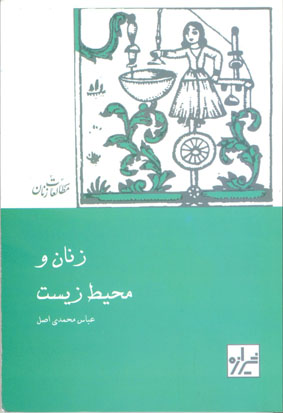
Women and the environment

The book “Women and the Environment” is one of the notable works of Dr. Abbas Mohammadi Asl, a prominent sociologist and professor at Allameh Tabatabai University. In this book, Dr. Mohammadi Asl examines “peaceful coexistence with nature” in today’s world, based on the principle that the love and perspective of women can restore the environment. “It seems that we live in a society where a narrow-minded, male-dominated approach to career advancement has led to great dangers for the environment, and therefore we must strive to replace the power of nature with a comprehensive, feminine perspective.”
Women and the environment have been formulated in 5 seasons: “Nature becomes captive to culture”, “Human nature becomes self-alienated”, “Nature becomes a way to find our mother”, “The environment becomes green in the absence of a ruler”, and “The blue sky becomes a world”.
The book begins with these sentences: “Nature or the environment is like a mother; because just like women and mothers are busy with the work of giving birth and producing offspring, and they are carriers of love; she lovingly produces and gives to humans.”
The first chapter deals with the environmental crisis and presents statistics and figures on how humans have exploited nature from the past until today. In this chapter, the book discusses three factors: private ownership, social alienation, and increasing human conflicts as the separation of humans from nature. The author strongly believes that the division of labor as a direct product of capitalism and the commodification of nature has alienated humans from themselves, while they are a part of nature, and immersed in monetary relationships (through buying and selling) that they forget their relationship with the land and nature, leading to increasing environmental destruction.
In the second chapter, the focus is on the important concept that in contemporary society, human identity is defined based on their consumption. Bourdieu’s theory of class consumption is referenced here, and various forms of human identity, such as consumer identity and social identity, are examined. In fact, the first two chapters of the book discuss the current situation and environmental crisis; how modernism has had important achievements for humanity, but at the same time has caused irreparable damage.
Chapter three also delves into the details of citizenship rights and their relationship with a democratic society and civil society. It then touches upon new environmental movements. The author sees these movements, which are more focused on peace, civil and gender rights, and environmental preservation, as a continuation of older social movements that fought for workers’ rights and unions, which have brought about changes in society and its structure. It is in this chapter that the relationship between feminism and the environment is discussed: “Ecofeminism, relying on the environment and human rights, is considered a new social movement that connects nature with women and, while using tangible indicators of environmental destruction and violation of human rights, draws on inner moral motivations and the unconscious conscience and anima of humans. Ecofeminism aims to liberate women by preventing ecological destruction, placing them on the front lines.”
The fourth chapter discusses the critique and evaluation of nature as a mother. The author writes with the approach that the use of the term “mother nature” is relevant to the era of motherhood and in the era of patriarchy, men misuse this term to exploit nature. He states, “The invocation of woman and nature as endless and invisible sources justifies the exploitation or freedom of man’s exploitation.” In the fifth chapter, the author examines the maturity of the male mind and proposes “the rise of a two-gendered wisdom” as a way to preserve the environment.
At the end of the book it is stated: “Sustainable development, based on the environmental conservation movement in the process of globalization, has equipped the world with a new global order based on gender equality, which, while taking a systemic approach to the biosphere and issues of economic and social development among advanced and underdeveloped nations, utilizes the integration of interests and affiliations to promote public participation.”
The book “Women and the Environment” which examines the perspective of gender towards the environment, was first published in 1388 (2009) by Shirazeh Publications in 196 pages. Reading this book is recommended for all human rights activists and defenders, regardless of any kind of ideology or gender.
Book Title: Women and the Environment
Author: Abbas Mohammadi Asl
Publisher: Shiraz Publishing and Research
Print date: First 1388
 Admin
Admin April 22, 2014