


Swelling
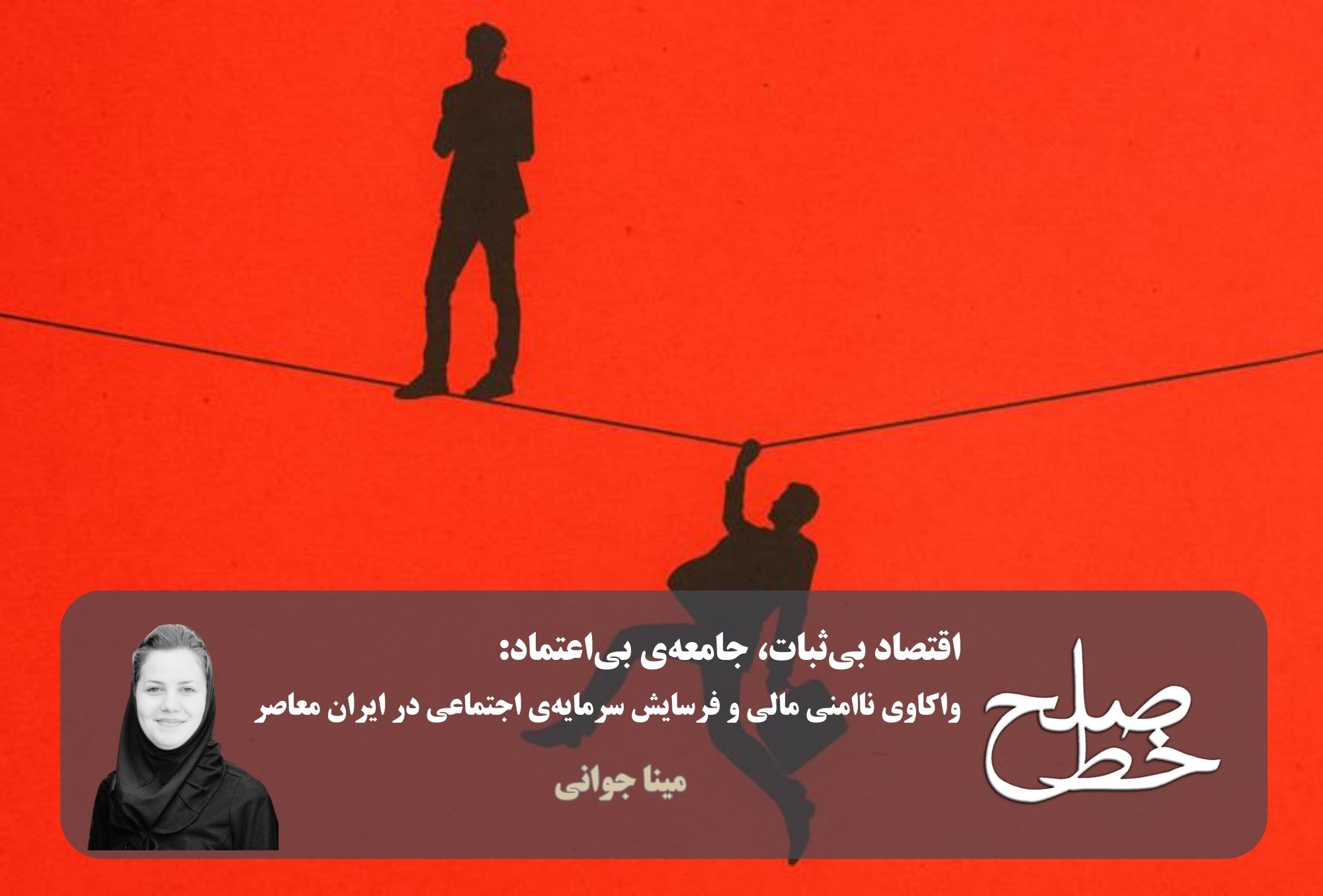
“Exploring Financial Insecurity and Erosion of Social Capital in Contemporary Iran / Mina Javani”
In the midst of the recent years’ intense transformations and chronic instabilities, Iranian society has been faced with a multifaceted erosion of social fabric; a situation that is not only observable in economic and political indicators, but also in the lived experiences of citizens. Among the key components of this multi-layered crisis, three phenomena stand […]...
Read More Created By:
Mina Javani
Created By:
Mina Javani April 21, 2025
Nowruz and the ailing economy of Iran; conversation with Sohrab Delangizan, university professor/ Azar Taherabadi
The Iranian economy has faced serious challenges in the final months of 1403, challenges rooted in structural factors and recent developments. High inflation, devaluation of the national currency, and economic recession are among the issues that have directly affected people’s purchasing power. In this regard, we sat down with Sohrab Delangizan, a full professor of […]...
Read More
Created By:
Azar Taherabad March 21, 2025
Housing Crisis in Iran; Challenges of Tenants and an Uncertain Future / Dina Ghalibaf
The housing crisis in Iran has become one of the most complex and critical economic and social issues in the country. Every year, with the increase in inflation rates and market fluctuations, housing costs also significantly rise, making it more difficult for different segments of society, especially young people and renters, to access suitable shelter. […]...
Read More
Created By:
Dina Ghalibaf February 19, 2025
Retirees in Iran: Asset or Burden?/ Alireza Goodarzi
News from the first deputy is being published, stating that retirees are a burden on the government and a financial burden; it is quickly denied and the news publisher is also arrested. These statements are representative of the same perspective we are familiar with: the worker is a burden on the employer, the sick are […]...
Read More
Created By:
Alireza Goodarzi June 21, 2024
Interview with Alireza Mirghafari, labor representative in the Supreme Council of Labor / Ali Kalai
The issue of minimum wage and its approval process in the Supreme Labor Council in the final days of last year sparked many discussions. Some media outlets referred to the method of determining it as a strange coincidence, and some used the term “wage suppression” to describe it. In this regard, and considering the importance […]...
Read More
Created By:
Ali Kalaei April 20, 2024
Conversation with Ali Khodayi, Vice President of the Supreme Council of Islamic Councils / Farzaneh Goli
Worker, is considered one of the most complex elements in the production process. Although workers receive lower wages compared to skilled labor, they play a vital role in the economic and production cycle. This is while they are clearly faced with issues such as delayed payment of wages. What causes workers to usually face difficult […]...
Read More
Created By: April 20, 2024
Rethinking the concept of poverty in Iranian working-class households / Amin Ghazaei
Economic indicators consider poverty as a “reduction in quality of life” or “deprivation”, meaning a decrease in access to material resources. Measuring the decline in income compared to the poverty line (poverty line index) or the decrease in purchasing power are major methods for calculating the level of poverty. In sociological studies, the social effects […]...
Read More
Created By:
Amin Ghazaie April 20, 2024
Living wage and struggle for survival/ Amir Aghaei
The struggle for survival is a term that is less used in today’s world and in the field of economy, but for workers, employers, and even the government, conditions have become so difficult and exhausting that they must fight for their survival and continuity of their activities. Workers and their families are worried about their […]...
Read More
Created By:
Amir Aghayi April 20, 2024
A Look at the Legal and Economic Issues of Contractual Workers in 1403/ Musa Barzin
In 1403, similar to previous years, the minimum wages of workers at various levels increased. We witnessed an increase of almost 35%. However, this amount is not enough to cover the expenses of a normal life, according to many experts. In other words, a citizen who is expected to have a normal life in exchange […]...
Read More
Created By:
Mousa Barzin April 20, 2024
Be careful, workers are sacrificing themselves. / Pedram Tahsini
According to the inflation reported by the Statistical Center of Iran and the Central Bank, we have extracted the monthly cost of living for a family of 3.3 members until the end of Azar month 1402 (December 2023) to be 23 million and 500 thousand tomans. This was stated by Mohsen Bagheri, the deputy head […]...
Read More
Created By:
Admin April 20, 2024
People have become the hidden victims of “low wages”/ Hormoz Sharifian.
Investigating the approved minimum wage for workers in 1403, still puts this hard-working spectrum of Iranian society at risk of countless social dangers, the headline of which is “poverty and misery”. This amount of wages, even with the sudden rise of the “dollar price” against the “destroyed national currency” – which intensified even more with […]...
Read More
Created By:
Hormoz Sharifian April 20, 2024
The Negative Effects of Low Wages on the Mental Health of Workers/ Saghar Rahimi
“Father didn’t give bread, father gave life. He had been absent for a long time; sometimes for temporary and difficult jobs in big cities, sleeping in cars and parks, and sometimes for months-long detentions in prison for protesting low wages, delayed payments, and harsh working conditions that had pushed him to the edge and eventually […]...
Read More
Created By:
Soghra Rahimi April 20, 2024
