


peace line

Placing thieves on social networks/ Ali Kalai
At one point, messages would come on social networks about someone from a distant country contacting you and saying that one of your relatives with a similar last name has passed away and left a huge fortune behind. Now, this person from the bank wants to transfer this money to you as the heir. However, […]...
Read More Created By:
Ali Kalaei
Created By:
Ali Kalaei March 20, 2024
Is it cunning or greed that is the victim?/ Pedram Tahsini
No sane mind can accept that a prohibited item can be sold at half price, but in Iran, nothing is impossible. Under heavy sanctions, anything is possible, including pre-ordering twenty iPhones at half price with the hope of making double profit, and of course, to prevent the national currency from becoming worthless in the bank […]...
Read More
Created By:
Admin March 20, 2024
Poverty of Women and Global Crises in the United Nations Commission on the Status of Women / Elaheh Amani
The 68th session of the Commission on the Status of Women (CSW 68) was held from March 11 to 22, 2024, with the participation of representatives from member countries of this commission, other United Nations bodies, and over 6,000 non-governmental organizations accredited by the Economic and Social Council of the United Nations (ECOSOC) from around […]...
Read More
Created By:
Elahe Amani March 20, 2024
On the occasion of “World Health Day” and its unfortunate situation in Iran / Hermoz Sharifian
April 1st (12th of Farvardin) has been designated as World Health Day. Health refers to a set of programs and actions that, when followed, promote the physical, mental, and spiritual well-being of humans, and proper implementation of which ultimately leads to the health of a society. In developed countries, health is one of the fundamental […]...
Read More
Created By:
Hormoz Sharifian March 20, 2024
World Water Day, or Mirage?/ Good Melody of Kowsar
For decades, many people have been celebrating World Water Day on the first week of the year and trying to awaken the sleepers on this day. But I mostly remember the Day of the Dead in Mexico (Día de los Muertos) where they drink, dance, and laugh in memory of the dead. Although I do […]...
Read More
Created By:
Nikahang Kowsar March 20, 2024
The secret of “the happiest country in the world” from the perspective of a Finnish psychologist / Parastoo Azizi
For consecutive years, Finland has been chosen as the happiest country in the world. Frank Martela, a Finnish researcher in psychology and philosophy, warns against making the mistake of assuming that Finns are inherently happy. Rather, they work hard to earn the title of the happiest people. “In fact, it is more accurate to say […]...
Read More
Created By:
Parastoo Azizi March 20, 2024
Nooruz no longer has the same atmosphere as before. / Keyomars Amiri
With just over a month left until the New Year and the celebration of Nowruz, the biggest ancient and traditional festival of Iranians, the markets were becoming crowded. The scent of perfume, rose water, incense, and spand were filling the air as vendors, especially street vendors, were setting up their stalls here and there. The […]...
Read More
Created By:
Kiomars Amiri March 20, 2024 Created By:
Admin March 20, 2024
Created By:
Admin March 20, 2024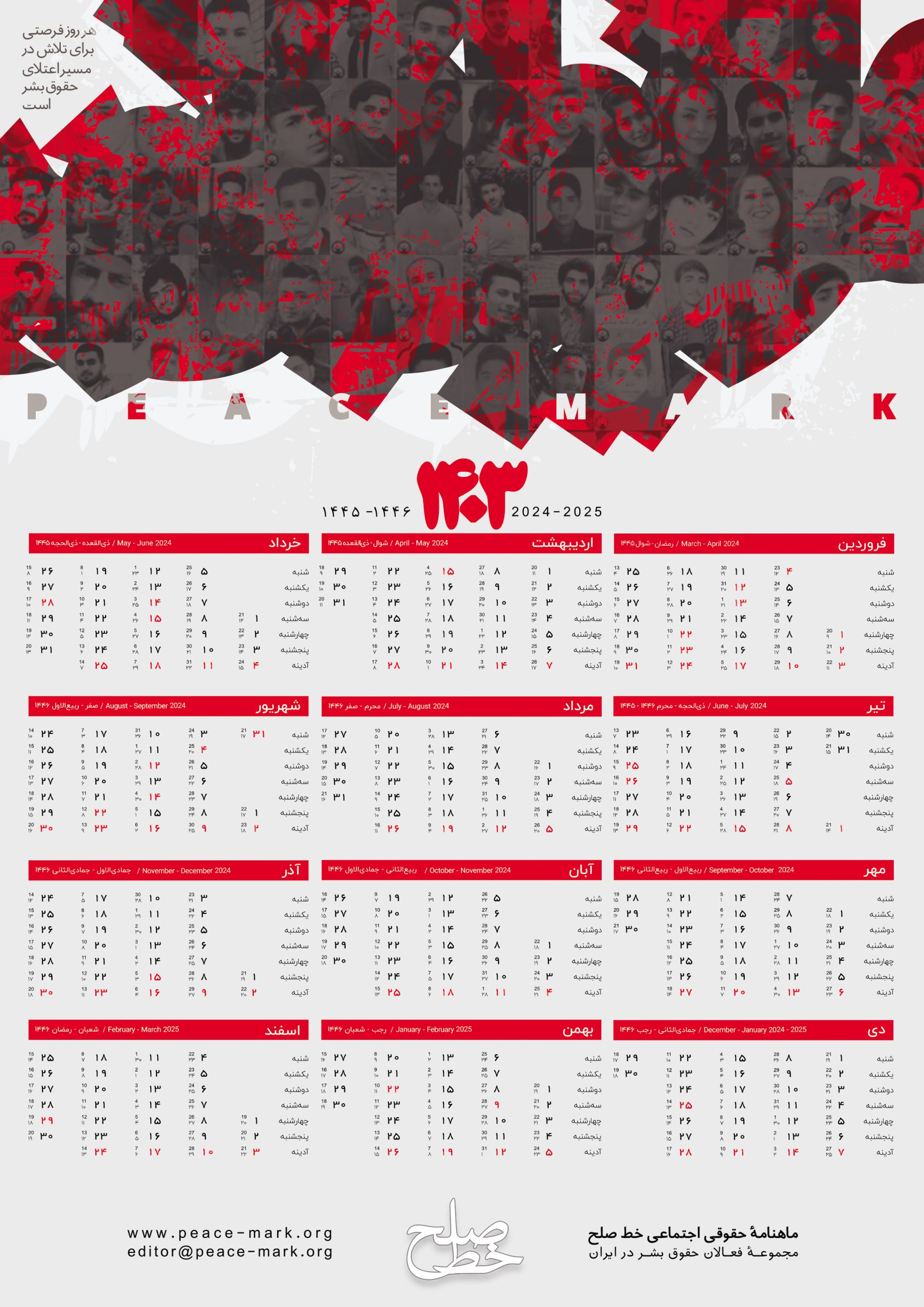
The 1403 Hijri Shamsi calendar dedicated to the audience of the peace line.
1403 Solar Hijri Calendar Dedicated to the Audience of the Peace Line...
Read More
Created By:
مدیر سایت March 20, 2024
Mohsen Haji Saeed: It is not possible to accuse every tourist of being a spy/ Dina Ghalehbaaf
Perhaps you have heard about the arrests of dual citizens or foreign tourists who have traveled to Iran for leisure. These arrests are often justified by security institutions claiming that these individuals are spies and have traveled to the country for espionage purposes. The question that arises in this situation is how valid this justification […]...
Read More
Created By:
Dina Ghalibaf February 20, 2024
Javad Ghasemi: The first condition for tourism development is security/ Ali Kalaei
A few days ago, a video went viral on social media. Lionel Messi, the Argentinian football star who is currently playing in the Saudi Arabian league, kicked a ball in a video promoting tourism for Saudi Arabia. After the release of this video, discussions about tourism in Iran resurfaced and became a hot topic. Under […]...
Read More
Created By:
Ali Kalaei February 20, 2024
Tourism, the driving force of the recession economy; in conversation with Mohammad Ali Shadi/ Matin Mostafaei
Out of all the climates present on our planet, only a few countries have the majority of possible geographical and climate conditions. Turkey has three, Iran has four, and America has five different climates. In the world, there are also five diverse climates. In addition, Iran and America have 24 UNESCO World Heritage sites, while […]...
Read More
Created By:
Matin Mostafaei February 20, 2024
