


Freedom of speech

“Return to the book, the true book!/ Saeed Barabadi”
The file of reading books by people around the world, especially Iranians, has changed significantly due to the coronavirus and long-term quarantines afterwards. However, in order to better understand this change, we must consider and accept the new types of reading in statistics, and acknowledge that all audio and visual products that are currently being […]...
Read More Created By:
Saeed Barabadi
Created By:
Saeed Barabadi October 23, 2023
Critical Thinking/ Sayed Mohammad Safi
My colleagues from “Peace Line” have asked me to share some points with our esteemed readers about the role of literature in fostering critical thinking and to encourage those interested to explore this necessary matter. How can accessing and researching the ancient literary roots of our culture contribute to the expansion and development of “critical […]...
Read More
Created By:
Seyed Mohammad Sohofi October 23, 2023
Censorship of books with semi-legal tools / Ehsan Haghi
A book is considered one of the most important tools for the transmission and dissemination of ideas. Therefore, one of the important measures of freedom of expression in a society is the freedom of individuals to express their thoughts and beliefs in the form of a book. Like all human rights and freedoms, freedom of […]...
Read More
Created By:
Ehsan Haghi October 23, 2023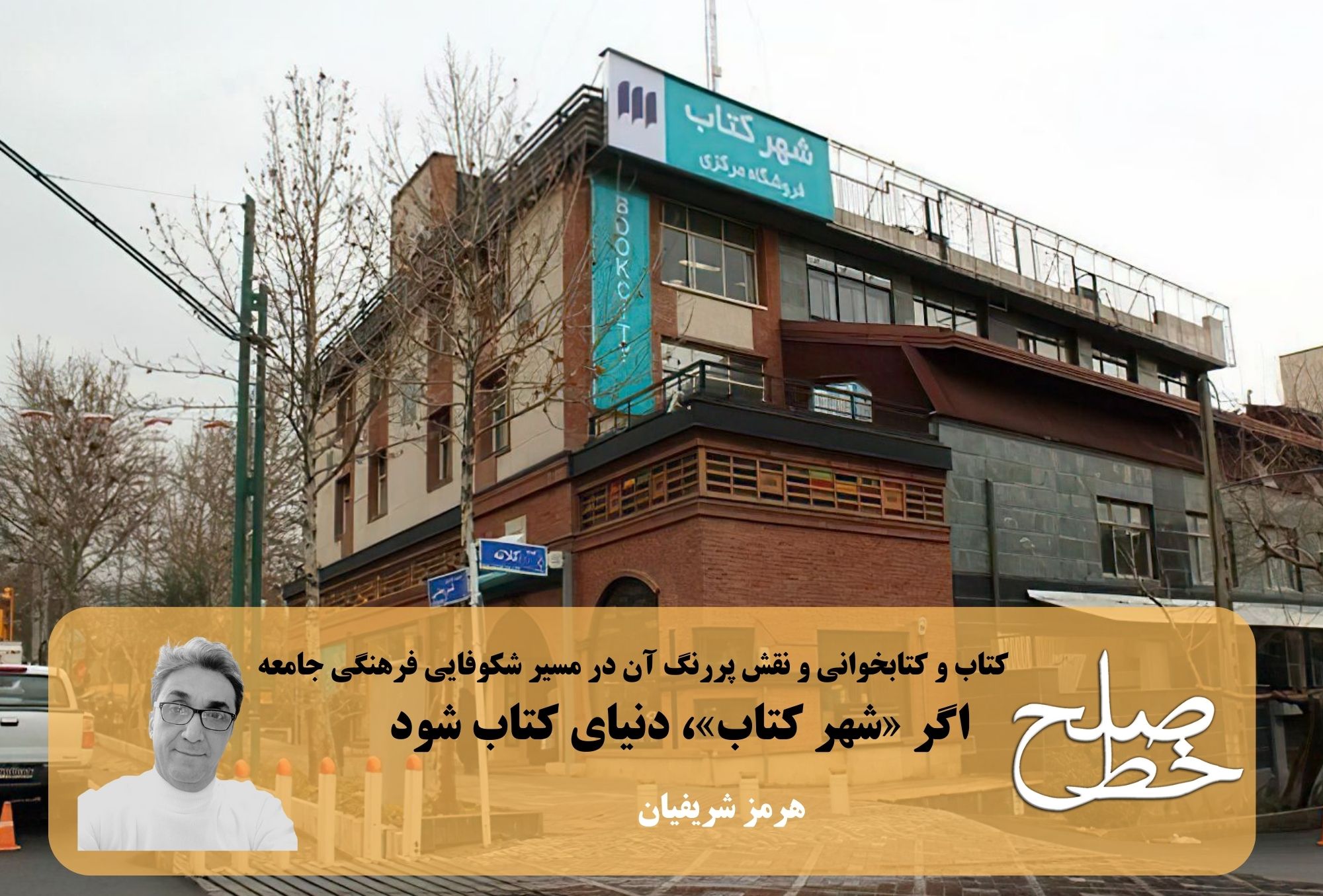
If “City of Books” becomes the world of books/ Hermoz Sharifian
The position and culture of reading books in Iran is so esteemed and respected that parents and teachers in schools, from the very first years of education, introduce books as humans’ best friend and encourage children to read, and of course, they still do so. Of course, verbal encouragement alone is not enough to establish […]...
Read More
Created By:
Hormoz Sharifian October 23, 2023
Our culture and its relationship with democracy / Majid Shia Ali
You have probably encountered views that suggest democracy requires cultural prerequisites and that society lacks these prerequisites culturally. To justify this view, various comparisons are made to belittle Iranian society compared to developed countries. From driving in heavy city traffic compared to driving conditions in Northern European countries, to the proposal of a per capita […]...
Read More
Created By:
Majid Shia’ali October 23, 2023
Non-compliance with international copyright laws and its impact on book publishing in Iran / Abdullah Bai Lashki
Iran, known for its rich literary heritage and ancient tradition of intellectualism, has served as a vibrant hub for writers, publishers, and literature enthusiasts for centuries. In a space where poetry, prose, and scientific works thrive, Iranian literary contributions both within and outside of the country have had a lasting impact. However, the emergence of […]...
Read More
Created By:
Abdullah Bai Lashaki October 23, 2023
Censorship, Reality, and Myths / Ahmad Faal
If we interpret myths as a desire for control and domination over reality, it may not be an exaggeration to say that most of us humans have a tendency towards myth-making. Our beliefs and convictions are a form of myth-making about real matters. The theories that arise in the humanities or even in technical and […]...
Read More
Created By:
Ahmad Fa’al October 23, 2023
The emergence of storytelling and the art of soil/ Morteza Hamounian
They tell us a story and want us to believe it as they have said it. Speech is the one that prevails, and its assumption is that no one questions the victor. They make their own narrative, define their own history, and with the reinterpretation of everything, they also appropriate concepts for their own benefit. […]...
Read More
Created By:
Admin October 23, 2023
A look at the pen against the sword of censorship / Arash Chakari
Censorship, subjective monitoring in cultural affairs, removal of artistic content through legal and illegal means, forced revision and rewriting, imposition of cultural preferences on the content of works, threats and intimidation, and countless other words and lines can be considered as subsets of this word: “censorship”; which is another name for all the lines above. […]...
Read More
Created By:
Admin October 23, 2023
The prominent role of media in exposing human rights violations / Hermoz Sharifian
From the beginning of the 19th century, when mass media, newspapers, and journalism emerged, all social fields from politics and culture to art and sports were influenced by this amazing phenomenon and found a new path towards progress and, in some cases, reached glory. Politics may have become entangled with journalism more than any other […]...
Read More
Created By:
Hormoz Sharifian September 23, 2023
Why is cultural generalization important? / Mehrdad Naghibi
More than ever, censorship and inspection policies by authoritarian governments have taken complex forms, to the point that in societies under the rule of tyranny and cultural suffocation, censorship and the policy of elimination have become a guillotine. In Iran, the issue of censorship, both in the Shah regime and in the Islamic Republic, has […]...
Read More
Created By:
Mehrdad Naghibi September 23, 2023
Supervision of the national broadcasting network on home display: Positioning/ Farshad Ghani
In the last days of the month of Khordad this year, Fars News Agency reported that “the Supreme Council of the Cultural Revolution discussed policies and regulations for the comprehensive audiovisual field in its 30th session, chaired by Seyyed Ebrahim Raisi” and approved the single article “Determination of Requirements for Organizing the Comprehensive Audiovisual Field”. […]...
Read More
Created By:
Farshad Ghani August 23, 2023
