


Book Introduction: Labor Unions and Self-Reliance in Iran
Habib Lajvardi (born in 1314 in Tehran) was the project manager of the Oral History of Iran project at the Center for Middle Eastern Studies at Harvard University. He successfully completed his Master’s degree at Harvard University and his PhD in Economics at the University of Oxford. After finishing his studies, Lajvardi returned to Iran and started working in his family’s business, Behshahr Industrial Group, in 1342.
He founded the Center for Management Studies in Iran in 1348 with the help of several management professors in Tehran and taught public policy until 1357, the beginning of the revolution. In 1360, he began the “Oral History Project of Iran” at Harvard University and, after 10 years, completed the project with the agreement of his colleagues.
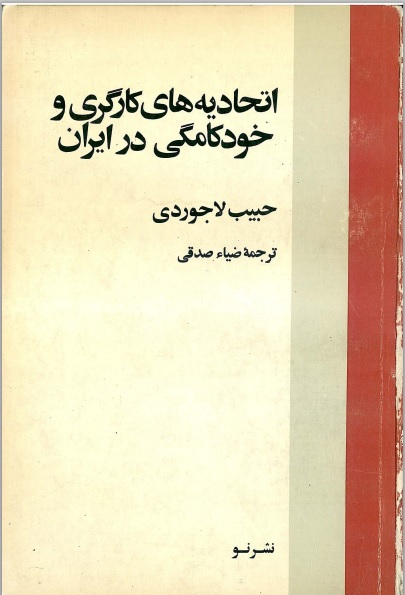
Dr. Lajvardi wrote the book “Labor Unions and Self-Reliance in Iran” which was published by the University of Syracuse Press, and a translation of it was released in Iran.
In the preface of this book, the author states: In the year 1357, Iran had undergone significant economic and social changes in comparison to the past half century and had achieved noticeable progress in these areas. This includes the establishment of an educational system that provided literacy to millions of children, the enactment of laws to promote women’s rights, and the construction of roads and factories. However, on the other side of the development triangle, the third side of political changes not only did not improve, but had negative growth.
He continues to discuss the ups and downs of political development in Iran through the lens of one aspect of political growth, namely the emergence of labor unions from 1282 to 1342. In fact, Lajvardi believes that labor unions are a suitable tool for measuring political development and adds that during periods of political freedom, labor unions were among the first institutions to appear on the political scene.
The chapters of this book, which introduce its content, are as follows:
1- The emergence of the workers’ movement, 2- The rebirth of labor unions, 3- Years of conflict 1323-1325, 4- Suppression of labor unions by the Tudeh Party 1325-1328, 5- Soviet influence in the workers’ movement, 6- British influence in the workers’ movement, 7- Influence of the employers in the workers’ movement, 8- Rise and fall of government-controlled unions 1325-1332, 9- Non-unionized workers 1332-1342, 10- British and American influence in the workers’ movement.
Dr. Lajvardi begins this book by describing the emergence of the labor union in Iran as follows:
In 1285, Mohammad Parvaneh and a group of workers established the first labor union in Iran at a small printing house located on Naseri Street in Tehran.
With the arrival of the year 1289, the workers of Tehran’s printing houses organized and formed the General Union of Printing Industry Workers. They published their own newspaper called “Worker’s Coincidence” and in Khordad 1289, they successfully went on strike. This was referred to by Iranian educator and researcher as “the first manifestation of a socialist or communist movement in Iran.”
The book “Labor Unions and Autonomy in Iran”, which examines the labor movement in the contemporary century, was first published in 1369 (1990) by Noor Publishing and translated by Zia Sadeghi in 498 pages. Reading this book is recommended to all activists and human rights defenders, regardless of any ideology.
 Created By: Admin
 September 26, 2014
Tags
Monthly magazine number 41