What is necessary for sexual minorities, but not enough / Razvaneh Mohammadi

Last updated:

May 22, 2026

What is necessary for sexual minorities, but not enough / Razvaneh Mohammadi

There is no Farsi text provided, so it is not possible to translate it into English. Please provide the Farsi text for an accurate translation.
Rezvaneh Mohammadi

The rights of sexual minorities in Iran are even considered marginal or insignificant by a large portion of the opposition. They are either talked about as something to be addressed in the future after the Islamic Republic, or only given attention in a basic way as a right to life for these individuals. Homosexuality is either taboo or seen as a secondary issue.

But the truth is that for the members of the Iranian LGBT community, these rights are neither secondary nor marginal; rather, they form the main framework of their lives. The right to life, in the sense of the right to live and the possibility of facing the death penalty for homosexuals, is part of the problem, and the other part is the right to social life and living without discrimination.

On the verge of May 17th, the day of fighting against homophobia, biphobia, transphobia, and intersexphobia, we can point to the underground and pressured social life of homosexuals and bisexuals in Iran. The emotional relationships and lifestyles of these individuals are widely ignored by their families and society, and factors such as legal pressures, criminalization of homosexuality, and fear of expulsion from educational or work environments make the situation even more difficult. Homosexual and bisexual students are at risk of being expelled from school and reported to their families if their sexual orientation is revealed, which can lead to further violence. In Iranian criminal laws, kissing and hugging between same-sex lovers is also considered a crime (Article 237 of the Islamic Penal Code). However, the implementation of the law does not end there. The expulsion of female football players and the suspension of the Malavan women’s football team are two symbols of the current situation. There is also increased pressure on female players

Despite the legal acceptance of transgenderism in Iran, the smallest rights for transgender individuals have not been considered. In current laws, only those who have undergone complete sexual reassignment surgery are able to change their identification documents to their desired gender. This means that the removal of reproductive organs (uterus, ovaries, or testicles) is a mandatory part of the transitioning process. These legal conditions, along with the mandatory hijab for women (all those whose identification documents identify them as female) and punishment for cross-dressing (punishment for wearing women’s clothing for those with male identification documents), practically prevent transgender individuals from expressing their identity. The laws are intentionally designed in a way to eliminate or force anyone who does not fit into the binary structure of male and female to conform or be eliminated.

In order to clarify the subject, it is necessary to first define two common phrases in the literature of gender and sexuality: gender identity and gender expression.

Gender identity is the deeply felt inner sense and personal experience of one’s gender, which may or may not align with the gender assigned at birth. It includes a personal connection to one’s body (which can be altered through medical, surgical, or other means with informed consent) and other expressions of gender such as clothing, speech, and behavior.

Gender expression refers to the display of an individual’s gender through their physical appearance, including clothing, hairstyle, accessories, makeup, behavior, speech, behavioral patterns, names, and pronouns. Gender expression can align with a person’s gender identity or may not align with it.

On one hand, there are current legal conditions, and on the other hand, there are international standards in this field. The formation of a compact session in 2006 at Gadjah Mada University in Indonesia was the starting point for writing a global standard on LGBT rights, known as the Yogyakarta Principles (2). The aim of this conference, which was attended by 29 experts from 25 different countries, was to design principles for the implementation of human rights in relation to sexual orientation and gender identity, which ultimately passed with the maximum votes. In fact, these principles specify the commitments of governments to implement human rights. The Yogyakarta Principles do not create any new rights, but rather provide a new interpretation of existing human rights laws. A valid legal interpretation written by special rapporteurs, members of UN working groups, judges, and academics. These principles do not specifically address heterosexuals, homosexuals, bisexuals, etc., but rather aim to provide a universal understanding of

Earlier, I mentioned the violation of the rights of homosexuals in Iran in terms of the right to life, equality, and non-discrimination. In continuation, I will address the standard that advocates for the implementation of these principles in this area.

The Principles of Yogacara.

The fourth principle of the Yogacara principles recognizes the right to life for all individuals with different sexual orientations or gender identities and obligates governments to revoke all laws against consensual relationships between two individuals of the same sex. Any government aggression towards the lives of these individuals must be stopped, and governments must ensure that they take action against the perpetrators of these attacks, whether they are from government forces or individuals or groups.

The second principle acknowledges that everyone, regardless of their sexual orientation or gender identity, has the right to full enjoyment of human rights without any discrimination. Everyone should be equal before the law and receive equal protection under the law. Discrimination in this law includes any distinction, exclusion, restriction, or preference. Any limitations on employment due to consensual same-sex relationships should be stopped and necessary measures should be taken to educate individuals and eliminate prejudice and discrimination based on sexual orientation, gender identity, or expression.

It should be noted that according to Principle 33 of the Yogjakarta Principles, the right to be free from criminalization based on sexual orientation, gender identity and expression, and sexual characteristics has been recognized. In 2017, 10 new provisions were added to the 29 principles adopted in 2006, explicitly calling for complete decriminalization in this area; whether in ordinary laws, religious laws, or under the guise of religious, customary, and moral justifications.

Are the principles of Yogacara similar to treaties or international agreements?

As we know, international treaties bind member countries to comply with the agreed upon terms through special mechanisms. In international treaties, there is no mention of sexual orientation, but when discussing the prohibition of any discrimination based on “sex” or “other grounds,” some interpreters also include sexual orientation and gender identity in these treaties. A famous example of this is the interpretation of the United Nations Human Rights Commission in 1994 regarding the prohibition of homosexual acts among men in Tasmania, which it described as dictatorial and unreasonable (4). This ruling was issued following a complaint by a homosexual man to the Human Rights Commission. He had lost his job due to his sexual orientation and believed this was a violation of Article 17 of the International Covenant on Civil and Political Rights, so he filed a complaint with the Human Rights Commission. In addition to international treaties, in 2016, a Special Rapporteur on sexual orientation and gender identity was created by the Human Rights Council, and for one year, Professor

In short, activists in this field in Iran can use the experiences of other countries and also rely on the principles of Yogjakarta to benefit from existing international mechanisms and strive to achieve the rights of sexual minorities.

Notes:

  1. روز جهانی مبارزه با هوموفوبی، ترنسفوبی و بایفوبیا

    International Day Against Homophobia, Transphobia and Biphobia

  2. For more information, go to .

    Website.

    The principles of Yogacarta, the principles of Yogacarta.

  3. For more information, refer to the .

    Website.

    The Principles of Yogacara, Principles of Yogacara + 10.

  4. For more information, refer to the .

    Website.

    The Australian Human Rights Commission studies complaints related to Australia and presents them to the Human Rights Committee.

  5. Intersex: A general term for individuals who are born with sexual characteristics and/or reproductive organs that do not align with the typical definitions of male or female. These differences are sometimes apparent at birth and sometimes not until puberty, and in some cases may not be apparent until the person’s death.

  6. Homophobia: Prejudice, fear, or hatred towards homosexual individuals.

  7. Biphobia: Prejudice, fear, or hatred towards bisexual individuals.

  8. Transphobia: Prejudice, fear, or hatred towards transgender individuals.

  9. Intersexuality: The term used to describe prejudice or different behavior towards an individual due to their different physical, hormonal, and genetic characteristics. When a person is not entirely male or female, but a combination of both or neither. Intersexuality can involve deprivation or inadequate access to medical services.

  10. Sexual characteristics: The physical features of an individual that are related to their gender; including sexual organs and other reproductive organs, chromosomes, hormones, and secondary physical characteristics that appear after puberty.

A buzz at the last Tehran International Book Fair / Reza Najafi

This is not a complete sentence and therefore cannot be accurately translated. Please provide a complete sentence for translation.
Reza Najafi

A brief history of the Tehran International Book Fair.

The Tehran International Book Fair is one of the most important cultural events in our country, which is held every year in mid-Ordibehesht (May). It should be noted that this year, the 32nd edition of this fair was held a little earlier, from the 4th to the 14th of Ordibehesht, due to its proximity to the month of Ramadan. This event was first held in 1987 at the permanent location of the International Fairgrounds (which later turned out not to be so permanent). Until 2006, the Tehran International Book Fair was held at the same location, to the point where the organization and format of the event, as well as its timing and location, became a tradition.

In the year 1386, however, other events took place. In this year, the location of the exhibition was moved to the Grand Mosque of Tehran under the pretext of reducing traffic, which caused a lot of talk and disputes between the Ministry of Culture and the publishers and book lovers, especially considering the transfer of traffic from the northern part to the center of the city. Additionally, some other actions of the government at the time (under the presidency of Mr. Ahmadinejad) and the Ministry of Culture, such as efforts to separate and relocate foreign publishers to another location, as well as changing the timing and location of the media exhibition from the International Book Fair, were seen by many publishers and book lovers as an attempt by the government to weaken publishers and the media, and were met with resistance.

In the year 1395, the location of the exhibition was moved to the city of Aftab, located in the south of Tehran; a decision that was met with criticism. Finally, after two editions of the Tehran International Book Fair being held in Aftab, the location of the fair returned to the Grand Mosque of Tehran in 1398; without satisfying many book lovers who had grown nostalgic for the permanent location of the fair (located at the end of Chamran Highway) after nearly two decades of visiting it. Overall, the uncertainty of having a permanent location for the fair, especially after 32 years of experience, and the repeated relocation from the mosque to Aftab and vice versa, has been one of the criticisms of the book community.

A little about the 32nd Tehran International Book Fair.

According to the information on official websites such as the Ministry of Culture and Islamic Guidance and the Tehran International Book Fair, with the slogan “Reading is Empowerment”, the 32nd Tehran International Book Fair was held from April 24th to May 4th, 2019 with the participation of 2400 domestic publishers (with 300,000 titles) and 800 foreign publishers (150 Arab publishers and 650 Latin publishers with 137,000 titles) from 30 countries in the Grand Mosalla of Tehran. Iranian publishers participated in this fair with 1400 new titles.

It should also be mentioned that this year, 73 publishers were banned from participating in this exhibition due to what the exhibition officials referred to as violations in the previous exhibition.

This exhibition was being held while there were concerns about the reception of the exhibition due to the ongoing floods in some provinces of the country and also discussions about economic sanctions. The increase in the price of paper to 50,000 tomans per bundle during the exhibition added to the worries of publishers to the point where talks of bankruptcy and closure of small publishers emerged. The rise in book prices and the astonishing decrease in the number of books at the recent exhibition were noticeable. According to many publishers, this year’s concerns are even more alarming than the issue of censorship, as the increase in prices threatens the printing and publishing industry of the country. Comparing the statistics of this year’s printing and publishing with last year’s shows a decrease of 100,000 copies at this year’s exhibition. While the Book House, as an official source, speaks of a 15% increase in book prices, many publishers are talking about a 100% increase by comparing the numbers.

It should be noted that this year, with the presence of a 200-member delegation, China was the special guest of this exhibition.

There were also banners in support of the Revolutionary Guards in the exhibition area, as well as various programs such as the “Islamic Resistance Celebration”, which were noteworthy.

At the same time, shortly before the exhibition was set up, the Tehran Writers Association protested in a letter to the Minister of Culture and Islamic Guidance against the ban on the distribution of several fictional and non-fictional works at the exhibition.

The following is mentioned in this letter: “Such decisions always remind us of the scars that each one brings a blurred memory of intentions to mind, which has an excessive desire to drive writers away from the people.” (1)

From the controversies of the 32nd Tehran International Book Fair, the withdrawal of the President, Mr. Rouhani, due to an unknown reason from visiting the fair and the presence of the Supreme Leader at the fair, and the spread of a video of him flipping through one of Ahmad Shamlou’s books on social media, which sparked a lot of online users’ opinions.

It is worth mentioning that, simultaneously with the Tehran International Book Fair, a group of Iranian publishers held a protest by organizing an exhibition titled “Uncensored Books” in several cities in Europe and North America.

A condensed version of critics’ perspectives.

If we overlook some minor criticisms such as the lack of clarity in determining the permanent location of the Tehran Book Fair and focus on the main criticisms, there are a few more points worth mentioning.

For foreign publishers, the first thing that stands out about the Tehran Book Fair is its distance from international exhibition standards. Experts have repeatedly pointed out that the Tehran International Book Fair is more of a bookstore than a place for publishers, writers, book distributors, and industry agents to exchange ideas. This criticism has even been acknowledged by officials, who are trying to improve the exhibition by implementing certain measures. For example, at the recent fair, officials announced that around 200 programs, including speeches and roundtable discussions, were held within the exhibition space. It should be noted that some of these programs, such as the celebration of Islamic resistance, have no connection to the book fair and have only added to the criticism.

The interference of various organizations in the Tehran Book Fair, such as the judiciary and the Revolutionary Guards’ intelligence organization, and the pressure to confiscate or collect certain books, is another criticism that is widely heard. Many publishers believe that parallel and non-parallel institutions are involved in the organization and arrangement of booths and other details of the fair, which leads to chaos in the fair.

But what stands out and is heard the most among all criticisms, is the discussion of creating restrictions and bans for the presence of certain books and publishers in the exhibition, as well as the collection of titles of books that have already passed through the filtering process and have obtained permission, yet have become victims of a second filtering.

Officials often deny criticism, but sometimes they express it without hesitation. It is possible that auditors have been careless in their work and now, with the warning of other institutions and individuals, they can gather what has been overlooked by the supervisory authority and prevent it from being displayed in the exhibition or allow it to be present.

This year, as in previous years, we witnessed some restrictions and prohibitions at the Tehran Book Fair. As a sample, we mention a few examples. According to the report of the Hrana News Agency, Emad al-Din Baghaei, a journalist, has stated on his personal Twitter account that officials from the Ministry of Culture and Islamic Guidance have contacted the publishing house and banned the publication of the book “Execution and Retribution”. He says that this ban has also been imposed on the book “Religion of the State and State of Religion” by Mohammad Ghouchani.

In another tweet, Mohammad Bagher Haqqani Fazl, a student and researcher in the field of religion, reported on the disobedience of three clerics from Qom, known as “Arabic Evaluators,” in the booths and collection of some books on the philosophy of religion (especially the book “Lahut al-Tanzih”) and even at times some books on the field of medicine.

Furthermore, the novel “The Condemned” written by Keyhan Khanjani has been deprived of participating in the Tehran Book Fair (2).

According to the report of the Herana News Agency, regarding the controversies surrounding the virtual exhibition, it has been mentioned that the books “Rahaband” by Hamid Cheshmavar, “The Hanging Doll” by Hormoz Saadollahi, “I Had Gone to Hell After Hell” by Ali Karimi Kalaye, and “Sibilo Women and Beardless Men: Gender Concerns in Iranian Modernity” by Afsaneh Najmabadi, translated by Athena Kamel and Iman Vaghefi, have been banned from being presented at the exhibition. Additionally, the book “Dictatorship with Brown Eyes” by Roya Ebrahimi has also been deprived of being displayed at the exhibition. Furthermore, according to the late Kourosh Asadi’s wife, who passed away in July 2017, the fourth edition of his novel “Lost Clouds Alley” has been banned from being published.

Mona Barzoi, a poet and lyricist, has also announced on her personal page on Instagram about collecting a collection of her love poems from an exhibition.

Three books from Kavir Publications have not received permission for display and distribution, even though more than ten years have passed since some of them were published. These three banned books are “Religion and New Challenges” by Ebrahim Yazdi, “Jurists and the Iranian Revolution” and “The New Thinkers of Religion” by Seyyed Hadi Tabatabai.

It should be noted that on the first days of the exhibition, the committee for dealing with publishers’ violations issued twenty-five one-day suspensions or until the end of the exhibition for booth-holding publishers, and one booth, which according to officials was selling “smuggled books”, was completely shut down (4).

This note has also come to an end, but the story still remains and the people of the book are worried about the increase in astronomical prices, the suffocating fall of the economy, the bankruptcy of publishers, and the continuation of unjustified auditing and confiscation of published works in the current year.

Notes:

  1. Why does Faraj Sarkoohi say that the Tehran Book Fair has turned into a “corpse”, Voice of America, 5th of Ordibehesht month, 1398?

  2. A report on widespread censorship and prohibition at the 32nd Tehran International Book Fair, Herana News Agency, 9th of Ordibehesht month 1398.

  3. طور که

    As

  4. The rose, Hasan, a look at the 32nd Tehran International Book Fair, Iran Star, 19th of Ordibehesht month, 1398.

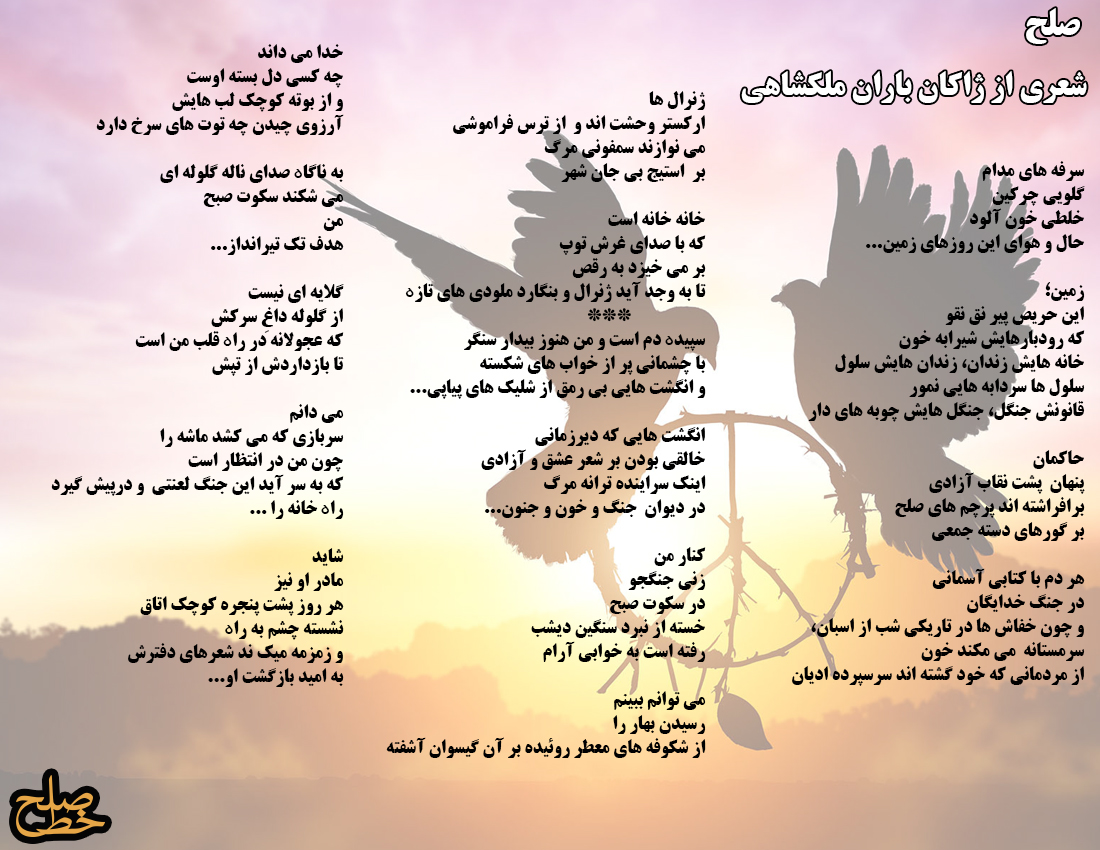
Peace – A poem by Zhakan Baran Malkshahi

This is a caption

This is a caption

Jakan Baran Malekshahi

Constant coughs

Dirty throat

Bloody phlegm

The weather of these days on earth…

Earth;

This greedy old man with a crooked nose

Whose rivers are streams of blood

His houses are prisons, his prisons are cells

The cells are cold and damp dungeons

His law is the jungle, his jungles are full of sharp wood

Rulers

Hidden behind the mask of freedom

They have raised flags of peace

Over mass graves

Every moment with a heavenly book

In the war of gods

And like bats in the darkness of night from horses,

Drunk, they spill blood

Of people who have become the shields of religions

Generals

They are the conductors of terror and out of fear of being forgotten

They play the symphony of death

On the lifeless stage of the city

Every house is a house

That rises to dance

With the sound of roaring cannons

So